Modern IT environments are no longer simple server rooms with a few monitoring dashboards. Today’s enterprises operate across hybrid cloud, edge, containers, microservices, and colocation facilities, all generating massive volumes of telemetry data. Traditional monitoring and manual incident response can’t keep pace.
AIOps (Artificial Intelligence for IT Operations) addresses this challenge by applying machine learning and advanced analytics to automate and enhance IT operations. This guide explains what AIOps is, how it works, its benefits and limitations, and how to implement it effectively in modern infrastructure environments.
What Is AIOps?
Artificial Intelligence for IT Operations or AIOps is a methodology that uses artificial intelligence (AI), machine learning (ML), and big data analytics to automate and improve IT operations processes.
The term was originally coined by Gartner, which defines AIOps as a platform that combines big data and machine learning to automate IT operations tasks.
In practical terms, AIOps platforms ingest large volumes of operational data, including logs, metrics, traces, and events, and use algorithms to detect anomalies in real time, correlate related alerts across systems, identify probable root causes, and automate remediation workflows.
AIOps is particularly valuable in environments built on hybrid and multi-cloud architectures, Kubernetes clusters, high-density virtualized infrastructure, and performance-intensive bare metal deployments. For organizations operating complex infrastructures such as bare metal servers or hybrid cloud environments, AIOps helps maintain performance and reliability at scale.
Discover the leading AI processors that can accelerate your projects.
Why AIOps Matters in Modern IT
IT operations teams are facing exponential growth in telemetry and event data. According to IDC, global data creation was expected to reach 175 zettabytes by 2025, and a significant portion of that growth is tied to cloud services, connected devices, and distributed applications. Every microservice call, API transaction, container deployment, and infrastructure event generates logs and metrics that must be stored, analyzed, and acted upon.
In this environment, IT teams struggle with alert fatigue, prolonged incident resolution times, increasing operational costs, and a higher risk of service disruptions. Traditional monitoring systems generate static threshold-based alerts that often lack context. As a result, engineers are forced to manually sift through dashboards and logs to piece together what happened and why.
AIOps changes the operational model from reactive to proactive. Instead of responding to isolated alerts, teams gain contextualized insights that link infrastructure signals to application behavior. This shift enables faster triage, more accurate root cause identification, and in many cases automated remediation before end users are affected.
The importance of AIOps becomes even more pronounced in hybrid environments that combine on-premises systems, cloud infrastructure, and colocation deployments. The operational complexity of such environments demands a level of analytical intelligence that exceeds what manual processes and rule-based monitoring can deliver.
AIOps Components
AIOps platforms are built on several foundational components. These components work together to transform raw operational data into actionable intelligence.
Data Ingestion and Aggregation
AIOps systems collect structured and unstructured data from multiple sources, including application logs, infrastructure metrics, network telemetry, cloud APIs, security tools, and ITSM platforms. This data often flows from monitoring solutions and observability stacks deployed across physical servers, virtual machines, and containers.
Big Data Processing
Given the scale and velocity of operational data, AIOps platforms rely on big data technologies capable of high-volume event streaming, real-time processing, and long-term historical storage. Distributed processing frameworks and scalable storage systems are critical for ensuring performance and model accuracy.
Machine Learning and Analytics
Machine learning models power the intelligence layer of AIOps. These models use supervised and unsupervised techniques, clustering algorithms, and time-series analysis to identify anomalies, detect patterns, and forecast potential incidents.
Automation and Orchestration
AIOps platforms integrate with orchestration tools to automate remediation steps such as restarting services, scaling compute resources, or triggering Infrastructure as Code workflows. Integration with DevOps pipelines enhances consistency and reduces human error.
How Does AIOps Work?
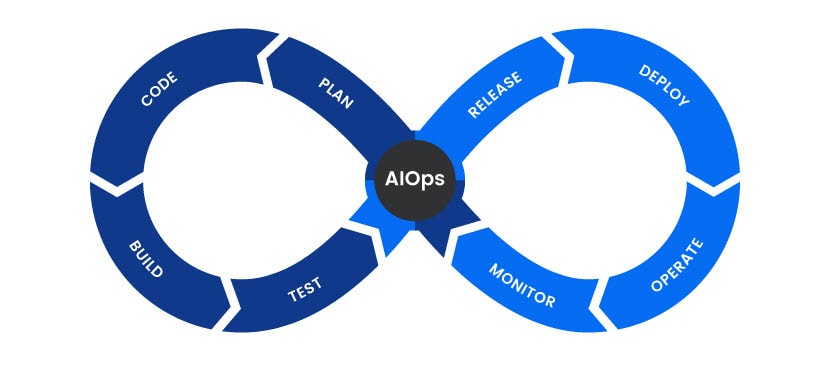
AIOps operates as a closed-loop intelligence system that continuously collects, analyzes, and acts on operational data across the entire IT environment. Unlike traditional monitoring systems that rely on static thresholds and predefined rules, AIOps platforms use machine learning models to dynamically interpret infrastructure and application behavior.
At a high level, AIOps transforms raw telemetry into actionable insight through a structured pipeline of data ingestion, processing, analysis, correlation, decision-making, and automated response.
Data Collection Across the IT Stack
The first step in AIOps is comprehensive data ingestion. The platform aggregates high-volume telemetry from:
- Infrastructure metrics such as CPU, memory, disk, and network utilization.
- Application logs and distributed traces.
- Event streams from monitoring tools.
- Cloud platform APIs.
- Configuration management databases.
- IT service management systems.
In hybrid and multi-cloud environments, this data may originate from on-premises servers, virtual machines, containers, Kubernetes clusters, and public cloud services. The broader and cleaner the dataset, the more accurate the resulting analysis.
Data Normalization and Context Enrichment
Raw operational data is often inconsistent and fragmented. AIOps platforms normalize and structure this data into a unified format. During this stage, the system enriches telemetry with contextual metadata such as:
- Host relationships.
- Application dependencies.
- Deployment versions.
- Infrastructure topology.
This contextualization is critical. For example, a CPU spike on a single server may appear insignificant in isolation, but when correlated with database latency and increased application error rates, it may indicate a broader incident.
Machine Learning Analysis
Once it has been normalized and enriched with context, operational data is processed using machine learning algorithms that form the analytical core of an AIOps platform. These algorithms are designed to operate at scale, analyzing high-velocity event streams and historical datasets simultaneously. Instead of relying on manually configured rules, the system identifies patterns, relationships, and behavioral baselines dynamically.
Machine learning in AIOps typically combines multiple techniques, including statistical modeling, clustering, neural networks, and time-series forecasting. Each technique contributes to a specific operational capability.
Anomaly Detection
Anomaly detection models establish behavioral baselines for infrastructure and applications. Rather than using static thresholds such as “CPU above 90 percent,” unsupervised learning algorithms analyze historical patterns to determine what is normal for a specific system under varying conditions.
For example, a database server may routinely operate at 85 percent CPU utilization during peak business hours. A traditional monitoring system might flag this as a warning. An AIOps platform, however, recognizes this as expected behavior and avoids generating unnecessary alerts. Conversely, if CPU usage spikes unexpectedly at 3 a.m. when workloads are typically minimal, the system flags this deviation as anomalous.
Advanced anomaly detection models can also account for seasonality, cyclic patterns, and workload variability. This dynamic baseline capability significantly reduces false positives and allows IT teams to focus on meaningful deviations that require intervention.
Event Correlation
Modern IT environments generate thousands of alerts per hour. Many of these alerts are symptoms of a single underlying issue. Event correlation algorithms analyze relationships between signals across infrastructure layers to group related alerts into a single actionable incident.
Clustering techniques and dependency mapping play a critical role here. For instance, if a storage subsystem experiences latency, downstream systems such as databases and applications may generate their own alerts. Instead of presenting each alert separately, AIOps identifies the dependency chain and consolidates them into one correlated event tied to the storage layer.
This contextual grouping dramatically reduces alert fatigue and accelerates triage. Engineers no longer waste time chasing secondary symptoms because the system highlights the primary cause and its cascading effects.
Root Cause Analysis
Root cause analysis in AIOps relies on graph-based models and historical pattern recognition. The platform maps relationships between services, infrastructure components, and application dependencies to construct a dynamic topology of the environment.
When an incident occurs, the system analyzes dependency paths and historical incident data to calculate the most probable root cause. For example, if multiple application services fail simultaneously, the system may determine that a misconfigured load balancer or network outage is the common denominator.
Probabilistic reasoning and causal inference models help refine these predictions over time. As the system observes repeated incident patterns and remediation outcomes, its ability to identify accurate root causes improves, reducing investigative effort and minimizing downtime.
Predictive Analytics
Predictive analytics extends AIOps capabilities beyond real-time detection into forward-looking forecasting. Time-series models analyze trends in performance metrics such as CPU utilization, memory consumption, network throughput, and storage capacity to predict future resource constraints.
For example, a predictive model may detect gradual increases in memory usage that indicate a potential leak in an application. Instead of waiting for an outage, IT teams can proactively patch or redeploy the service. Similarly, capacity forecasting models can estimate when storage systems or compute clusters will require scaling.
By combining historical data with real-time telemetry, predictive analytics transforms IT operations from reactive troubleshooting to proactive optimization. This capability is particularly valuable in hybrid cloud environments, where cost efficiency and resource planning are critical.
Intelligent Decision-Making
After identifying anomalies or incidents, AIOps platforms evaluate response options. Depending on configuration, the system may:
- Generate prioritized alerts.
- Recommend remediation actions.
- Trigger automated workflows.
- Escalate incidents within ITSM tools.
Decision engines often incorporate policy rules, risk scoring, and compliance constraints to ensure actions align with organizational standards.
Automation and Remediation
The final step involves executing corrective actions. Through integration with orchestration tools and Infrastructure as Code platforms, AIOps can initiate automated remediation such as:
- Restarting failed services.
- Scaling infrastructure horizontally or vertically.
- Reconfiguring load balancers.
- Rolling back faulty deployments.
- Provisioning additional compute capacity.
In cloud-native environments, this enables self-healing infrastructure. For example, if a microservice instance begins exhibiting abnormal latency, AIOps can correlate the anomaly, determine probable root cause, and trigger automatic scaling or redeployment.
Continuous Learning and Feedback
A defining characteristic of AIOps is continuous improvement. The platform evaluates the effectiveness of remediation actions and updates models accordingly. Successful resolutions reinforce model accuracy, while incorrect predictions inform retraining.
This feedback loop ensures that the system adapts to evolving infrastructure patterns, application updates, and architectural changes.

Types of AIOps
AIOps platforms can generally be categorized based on their scope and the breadth of operational domains they cover.
Domain-Centric AIOps
Domain-centric AIOps tools focus on a specific area of IT operations, such as network monitoring, application performance monitoring, or cloud resource optimization. These solutions are designed to provide deep, specialized insights within a narrow domain.
For example, a domain-centric platform tailored for application performance may leverage advanced tracing and code-level analytics to detect performance bottlenecks within microservices. Similarly, a network-focused AIOps tool may concentrate on traffic anomalies, latency spikes, and configuration drift.
While these tools provide strong depth and precision, they may lack visibility across interconnected systems. In complex hybrid infrastructures, incidents often span multiple layers including application, network, compute, and storage, which makes isolated domain analysis insufficient.
Domain-Agnostic AIOps
Domain-agnostic AIOps platforms aggregate and analyze data across multiple operational domains. Rather than focusing solely on one layer of the stack, they correlate signals from infrastructure, applications, networks, security systems, and cloud environments.
This holistic approach is particularly valuable for enterprises operating across on-premises data centers, public cloud providers, and colocation facilities. By analyzing cross-domain data, these platforms can uncover hidden dependencies and pinpoint root causes that span multiple systems.
Although domain-agnostic solutions may require more extensive integration and data normalization, they provide a unified operational view that is essential for large-scale, distributed environments.
Stages of AIOps
Organizations typically adopt AIOps in progressive stages, gradually increasing operational maturity and automation capabilities.
Visibility
The first stage of AIOps focuses on consolidating observability data into a centralized platform. At this point, organizations unify logs, metrics, events, and traces from across their infrastructure. This stage establishes a single source of truth for operational data.
Achieving visibility often requires integrating legacy monitoring systems, cloud-native observability tools, and on-premises telemetry sources. Without comprehensive data collection, machine learning models cannot produce accurate insights. Visibility is therefore the foundation upon which all other AIOps capabilities are built.
Insight
Once data is centralized, the next stage involves applying analytics and machine learning to generate actionable insights. During this phase, organizations implement anomaly detection, event correlation, and pattern recognition capabilities.
Instead of receiving hundreds or thousands of isolated alerts, operations teams begin to see correlated incidents with contextualized explanations. The system may identify that a database latency spike is connected to storage saturation and increased CPU usage, significantly reducing investigation time.
This stage improves operational intelligence but still relies heavily on human decision-making for remediation.
Automation
In the automation stage, AIOps platforms begin executing predefined remediation workflows. These workflows may include restarting services, provisioning additional compute resources, or modifying load balancer configurations.
Automation reduces mean time to resolution and limits human intervention in repetitive tasks. However, organizations must implement strong governance controls to ensure automated actions align with security and compliance requirements.
This stage represents a shift toward self-healing infrastructure, particularly in cloud-native and IaC environments.
Optimization
The final stage combines predictive analytics and historical trend analysis to optimize performance and resource allocation. Instead of merely reacting to anomalies, organizations forecast capacity needs, identify inefficiencies, and proactively adjust configurations.
For example, predictive models may identify seasonal traffic patterns and automatically adjust scaling policies to prevent resource shortages. This stage enables continuous improvement and cost optimization across hybrid infrastructure environments.

AIOps Tools
The AIOps ecosystem includes both standalone platforms and integrated enterprise solutions. Examples include IBM AIOps Solutions, ServiceNow ITOM with AIOps, AWS DevOps Guru, Dynatrace Davis AI, and Splunk ITSI.
When evaluating tools, consider integration capabilities, scalability across hybrid environments, support for automation frameworks, and compliance requirements. Organizations operating dedicated infrastructure such as bare metal cloud should ensure the platform supports physical server telemetry alongside virtualized and cloud-native environments.
AIOps Advantages
AIOps provides measurable operational and strategic benefits when properly implemented.
Reduced Alert Fatigue
One of the most immediate benefits of AIOps is the reduction of alert noise. Traditional monitoring tools often generate redundant or low-value alerts based on static thresholds. AIOps platforms apply correlation algorithms to group related alerts into meaningful incidents, significantly reducing the number of notifications engineers must review.
This consolidation improves focus and enables teams to prioritize critical issues rather than responding to symptoms.
Faster Mean Time to Resolution
By identifying probable root causes and presenting contextualized insights, AIOps accelerates incident resolution. Instead of manually investigating multiple dashboards, engineers receive consolidated information that narrows the scope of troubleshooting.
Faster mean time to resolution improves service reliability and reduces the business impact of downtime, especially for revenue-generating applications.
Proactive Incident Prevention
Through anomaly detection and predictive analytics, AIOps can identify emerging risks before they escalate into outages. For example, gradual memory leaks or abnormal traffic patterns can be flagged early, enabling corrective action before users experience disruptions.
This proactive approach represents a shift from reactive firefighting to preventative operations.
Improved Resource Utilization
AIOps analyzes infrastructure performance trends to optimize resource allocation. By identifying underutilized or overprovisioned systems, organizations can improve efficiency and reduce unnecessary cloud or hardware expenditures.
For high-performance workloads, including enterprise databases, resource optimization directly impacts application performance and cost management.
Enhanced Operational Scalability
As IT environments expand, manual monitoring processes become unsustainable. AIOps enables operations teams to manage larger infrastructures without proportional increases in staffing. This scalability is essential for organizations pursuing digital transformation and cloud expansion strategies.
AIOps Disadvantages
Despite its advantages, AIOps presents certain challenges that organizations must address.
Implementation Complexity
Deploying AIOps requires integrating multiple data sources, configuring machine learning models, and aligning workflows with existing IT service management processes. This complexity can increase implementation timelines and require specialized expertise.
Without a structured rollout plan, organizations may struggle to achieve meaningful results.
Data Quality and Governance Issues
Machine learning models are only as reliable as the data they process. Inconsistent logging standards, incomplete telemetry, and noisy datasets can lead to inaccurate insights or false positives.
Establishing strong data governance policies and normalization processes is essential for maintaining model integrity.
Integration with Legacy Systems
Legacy infrastructure may lack modern telemetry capabilities or standardized APIs. Integrating such systems into an AIOps platform can require additional tooling or custom development, increasing both cost and complexity.
Organizations operating hybrid environments must carefully assess compatibility before deployment.
Risk of Overreliance on Automation
While automation improves efficiency, excessive reliance on automated remediation may introduce unintended consequences. Improperly configured workflows can exacerbate incidents rather than resolve them.
Maintaining human oversight and implementing approval mechanisms for critical changes is crucial for mitigating this risk.
How to Implement AIOps
Implementing AIOps begins with defining clear operational objectives. Organizations should establish measurable goals, such as reducing incident resolution times or decreasing alert volume. These objectives guide tool selection and deployment strategy.
The next step involves consolidating data sources. Logs, metrics, and event streams must be centralized into a unified observability platform to ensure machine learning models have access to comprehensive datasets. This often requires standardizing logging formats and improving telemetry coverage across infrastructure layers.
Organizations should then prioritize high-impact use cases. Instead of attempting enterprise-wide automation immediately, teams can focus on areas with frequent incidents or significant operational cost. Examples include cloud auto-scaling optimization or recurring application performance anomalies.
Finally, successful implementation requires continuous model training and performance evaluation. AIOps is not a one-time deployment but an evolving operational capability. Regular review cycles ensure the system adapts to infrastructure changes and maintains accuracy over time.
AIOps vs. Traditional IT Operations
Traditional IT operations rely heavily on manual processes and rule-based monitoring. Static thresholds trigger alerts when predefined limits are exceeded, but these alerts often lack context and correlation. Engineers must manually investigate incidents by examining multiple data sources, which increases response times and introduces the risk of human error.
In contrast, AIOps systems analyze patterns across historical and real-time data to detect anomalies dynamically. Rather than responding to isolated alerts, teams receive correlated incidents with probable root cause insights. This data-driven approach reduces investigative effort and enables predictive capabilities that traditional monitoring tools cannot provide.
In dynamic environments such as hybrid cloud or Kubernetes-based architectures, the limitations of static rule-based systems become increasingly apparent. AIOps offers the adaptive intelligence necessary to manage complex, distributed infrastructure at scale.
How Can phoenixNAP Help with AIOps?
AIOps delivers the most value when deployed on reliable, scalable infrastructure. phoenixNAP provides enterprise-grade infrastructure solutions that support AIOps initiatives, including:
- Bare Metal Cloud for high-performance workloads.
- Colocation services in secure data centers.
- Hybrid cloud deployments.
- Backup and disaster recovery solutions.
With secure, high-availability data center environments and flexible infrastructure options, phoenixNAP enables organizations to collect, process, and analyze operational data efficiently, forming the foundation for successful AIOps implementation.

AIOps as the Foundation of Intelligent IT Operations
AIOps is transforming IT operations by combining artificial intelligence, big data, and automation into a unified operational intelligence framework. As infrastructure environments grow more complex, organizations that embrace AIOps will gain a decisive advantage in reliability, scalability, and operational efficiency.
AIOps FAQs
Below you will find answers to the most common questions relating to AIOps.
What Is the Difference Between AI and AIOps?
AI is a broad field focused on enabling machines to simulate human intelligence. AIOps is a specialized application of AI that applies machine learning and analytics specifically to IT operations and infrastructure management.
Is AIOps Only for Large Enterprises?
While large enterprises benefit significantly from AIOps, mid-sized organizations operating hybrid or cloud-native environments also gain value, especially when managing complex distributed systems.
Does AIOps Replace DevOps?
No. DevOps focuses on development and deployment practices, while AIOps optimizes operational intelligence. AIOps complements DevOps by enhancing operational visibility and automating incident management.
Can AIOps Improve Security Operations?
Yes. By analyzing logs and network telemetry, AIOps can detect abnormal patterns that may indicate security incidents. However, it should complement, not replace, dedicated SIEM and security platforms.
How Long Does It Take to See ROI from AIOps?
Return on investment depends on implementation scope and data maturity. Organizations typically see measurable improvements in alert reduction and incident resolution within several months of deployment.
Is AIOps the Same as Observability?
No. Observability provides visibility into system behavior through logs, metrics, and traces. AIOps builds on observability by applying AI and automation to act on that data intelligently.