Fortran is a high-performance programming language designed for numerical computation and scientific computing. It is widely used for large-scale data analysis and efficient execution on modern CPUs and supercomputers, as it supports parallelism, modular design, and interoperability with C and other languages.
Originally developed in the 1950s, Fortran remains relevant, as large scientific codebases in physics, climate science, computational chemistry, and engineering rely on modern Fortran standards.
This guide will explain what Fortran is, its history, versions, common use cases, core concepts, benefits, and challenges.
What Is Fortran?
Formula Translation (Fortran) is a compiled programming language designed for numerical and scientific computation. It translates source code into instructions that the computer executes directly, which improves performance for calculation-heavy tasks. The language requires developers to specify the data type of each variable, which reduces errors and improves program stability.
Fortran was built for mathematical and engineering problems. It handles large sets of numbers, multi-dimensional arrays, and high-precision calculations efficiently. These characteristics make it well-suited for simulations, modeling, and large-scale scientific analysis.
Fortran is defined by international ISO standards instead of a single company. This means no single vendor controls how the language evolves. Therefore, programs written in Fortran continue to work across different compilers and platforms over long periods, which is important in scientific and enterprise environments where software often runs for decades.
Brief Fortran History
Fortran was created in the 1950s by a team at IBM led by John Backus. At the time, programmers wrote instructions in assembly language, which required detailed knowledge of hardware and made large scientific programs difficult to manage. Fortran helped write mathematical formulas in a form closer to human reasoning, which made programming faster and more practical for scientists and engineers.
The first official release, Fortran I, appeared in 1957. It focused on numerical calculations and was used in research and engineering environments. Over time, new versions improved the structure, reliability, and portability, which allowed older scientific programs to still run while new features were added.
Unlike many early programming languages, Fortran is still present. Instead, it evolved through formal standards that expanded its capabilities and preserved compatibility with existing code used in laboratories, universities, and large computing centers.
Fortran Versions
Fortran has developed through a series of formal language standards. Each new version introduced features that improved structure, performance, portability, or parallel execution, but still allowed older code to work.
The table below outlines the major Fortran versions and their key additions:
| Version | Year | Key Changes |
|---|---|---|
| Fortran I | 1957 | First high-level scientific programming language. Designed for numerical computation on IBM mainframes. |
| Fortran II | 1958 | Added support for separate compilation and subroutines, which allowed larger programs to be divided into reusable parts. |
| Fortran III | 1958 | Experimental release. Not widely adopted, but contributed to subsequent standards. |
| Fortran IV | 1962 | Improved portability across systems and clarified language rules. Became the IBM standard. |
| Fortran 66 | 1966 | First official standard by ANSI. Defined a stable specification for compilers. |
| Fortran 77 | 1978 | Introduced structured control statements, such as IF...THEN...ELSE and improved character data handling. |
| Fortran 90 | 1991 | Major redesign. Added modules, array operations, dynamic memory allocation, and free-form source format. |
| Fortran 95 | 1997 | Refinement of Fortran 90 with improved performance features and clearer language rules. |
| Fortran 2003 | 2004 | Introduced object-oriented programming features and interoperability with the C programming language. |
| Fortran 2008 | 2010 | Added coarrays for parallel programming and enhanced support for concurrent execution. |
| Fortran 2018 | 2018 | Expanded parallel programming features and improved integration with C. |
| Fortran 2023 | 2023 | Improved error handling, enhanced generics support, and further clarified parallel and interoperability features. |
The most significant modern updates began with Fortran 90, which shifted the language from older procedural styles to structured and modular programming.
Later standards, such as Fortran 2003 and beyond, expanded support for object-oriented design and parallel execution, which enables Fortran to remain competitive in high-performance computing environments today.
Fortran Use Cases
Fortran is used in fields that require precise numerical computation, large datasets, and predictable performance.
The main areas where Fortran is commonly used include:
- Financial modeling. Some quantitative finance systems use Fortran for risk modeling and large-scale numerical analysis where execution speed matters.
- Weather and climate modeling. National meteorological agencies use Fortran to simulate atmospheric behavior and predict long-term climate patterns on supercomputers.
- Physics simulations. Researchers model particle interactions, fluid dynamics, and astrophysical systems where numerical precision is critical.
- Engineering analysis. Aerospace, mechanical, and civil engineers use Fortran for structural analysis, computational fluid dynamics, and stress testing of complex systems.
- Computational chemistry and biology. Molecular modeling and quantum chemistry software often rely on Fortran for high-precision calculations.
- High-performance computing (HPC). Supercomputers run scientific workloads written in Fortran because it performs well with parallel frameworks such as MPI and OpenMP.
- Energy and nuclear modeling. Power grid simulations, reactor modeling, and energy optimization systems often use Fortran for long-term reliability and performance.
How Does Fortran Work?
Fortran programs follow a clear workflow from writing code to running calculations. Understanding this workflow helps explain why Fortran performs well in scientific and engineering applications.
The process breaks a program into stages, which ensures it runs efficiently and reliably on modern computers.
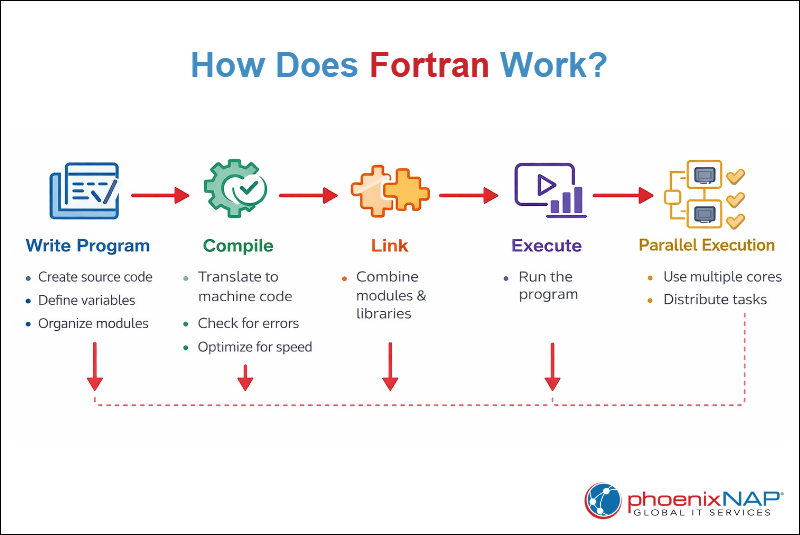
The stages are:
- Writing the program. Developers create the source code with a text editor or development environment. The code includes instructions for calculations, data processing, or simulations. At this stage, programmers define variables, choose data types, and organize the program into modules or subroutines for clarity and reusability.
- Compilation. The Fortran compiler checks the source code for errors and translates it into instructions the computer can execute. The compiler also arranges calculations and memory use for speed and efficiency. This stage converts human-readable code into a form a computer is able to process directly.
- Linking. If a program uses multiple modules or external libraries, the compiler combines them into a single executable file. Linking ensures all program parts communicate correctly, and the final program includes any necessary built-in functions or libraries.
- Execution. The computer runs the executable program. The instructions perform the calculations, process data, and produce results. Modern Fortran supports parallel execution, which allows multiple parts of the program to run simultaneously on different CPU cores or across distributed systems. This parallelism improves performance for large-scale numerical problems.
Key Fortran Concepts
Fortran includes several core concepts that define how programs are structured and numerical calculations are performed. These concepts focus on data organization, mathematical operations, and program structure.
The core concepts are:
- Parallel features. Modern Fortran includes support for parallel execution through features such as coarrays and integration with parallel frameworks. This allows programs to divide work across multiple processors when they handle large numerical problems.
- Data types. Fortran requires developers to declare the type of each variable. Common types include integers for whole numbers, real numbers for decimal values, and complex numbers for calculations that involve real and imaginary parts. Defining data types helps prevent calculation errors and improves program stability.
- Arrays. Arrays store multiple values under a single name. Fortran supports multidimensional arrays, which makes it suitable for work with matrices, grids, and large scientific datasets. Scientific calculations often operate directly on entire arrays instead of individual elements.
- Predefined functions. Fortran provides built-in functions for common tasks such as mathematical operations, trigonometric calculations, and data handling. They reduce the need to write repetitive code and improve readability.
- Modules. Modules group related variables, functions, and procedures into a single unit. This structure improves code organization and allows reuse across large projects.
- Subroutines and functions. Programs can be divided into smaller, reusable blocks of code. Subroutines perform tasks without a return value, while functions return a result. This structure makes complex programs easier to manage.
Fortran Benefits
Fortran remains widely used for its strong performance and long-term reliability in scientific and engineering environments. Its design focuses on numerical computation, which enables it to handle large calculations efficiently.

Some significant benefits of Fortran are:
- Mature ecosystem. Scientific libraries, numerical packages, and legacy systems rely on Fortran. It provides tested tools for research and industrial applications.
- High performance. Fortran compilers optimize numerical calculations effectively. This allows programs to process large datasets and complex mathematical operations with minimal overhead.
- Efficient array handling. The language works naturally with multidimensional arrays and matrix operations. Many calculations apply to entire arrays at once, which improves readability and execution speed.
- Long-term stability. Fortran evolves through formal international standards. Programs written decades ago continue to run with modern compilers, which protects long-term research investments.
- Scalability. Fortran supports parallel execution and works well on supercomputers and distributed systems. This makes it suitable for large simulations and scientific modeling.
Fortran Challenges
Despite its strengths, Fortran has limitations that affect adoption in some areas.
The language was designed for numerical computation, not for general-purpose application development. Therefore, it is not always the best choice outside scientific and engineering domains.
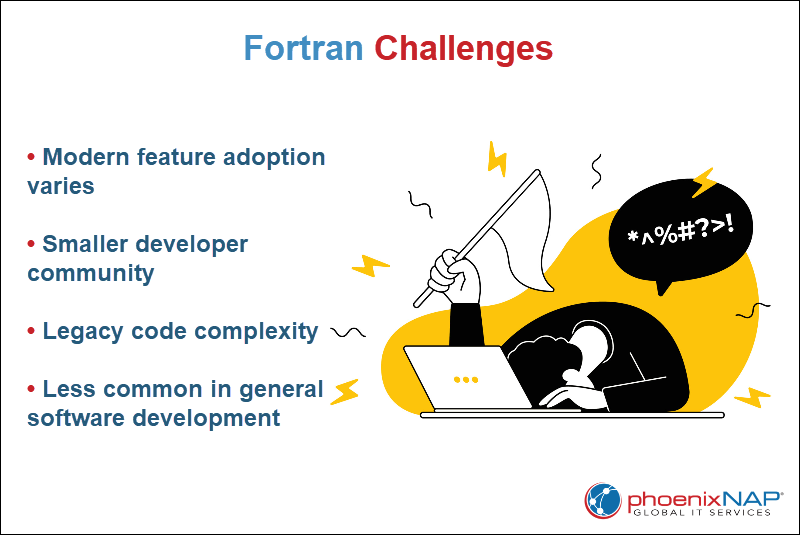
The main challenges include:
- Modern feature adoption varies. While recent standards include object-oriented and parallel features, not all legacy systems use them. Some organizations continue to rely on older coding patterns.
- Smaller developer community. Compared to languages such as Python or C++, fewer developers learn Fortran today. This sometimes makes it more difficult to hire and train.
- Legacy code complexity. Many large Fortran systems were written decades ago. These codebases are difficult to maintain if they use outdated programming styles.
- Less common in general software development. Fortran focuses on numerical computation and scientific workloads. It is rarely used for web development, mobile applications, or consumer software.
Conclusion
This tutorial explained what Fortran is and its history. It also presented its significant versions and use cases. The text elaborated on how the language works and listed its common benefits and challenges.
Next, learn about the top ten AI programming languages.