Pulumi is a modern tool that helps you manage infrastructure using code. Instead of setting up servers, networks, and cloud resources by clicking through dashboards, you can define everything in simple programming languages like Python, JavaScript, or Go. This approach is called infrastructure as code (IaC), and it makes your systems easier to build, update, and scale.
In this article, you’ll learn what Pulumi is, how it works, and why it’s a good choice for managing infrastructure faster and more reliably.
An Introduction to Infrastructure as Code
Infrastructure as Code is a way to set up and manage servers, networks, and cloud resources using code instead of manual steps. Teams define the desired infrastructure in files, making deployments repeatable, version-controlled, and easier to update, audit, and recover. This makes it easy to repeat setups, track changes, and fix issues quickly, since everything is defined clearly and can be reused or updated just like regular code.
phoenixNAP’s Bare Metal Cloud is fully compatible with IaC automation tools. Together, they enable near-instant server deployment to support DevOps.
For more information, refer to our GitHub pages for Ansible, Terraform, Chef, and Puppet.
What Is Pulumi?
Pulumi is a tool used to build and manage cloud infrastructure using general-purpose programming languages like Python, JavaScript, TypeScript, Go, and C#. Instead of learning a special configuration language, it uses standard code to create servers, databases, networks, and other resources. Pulumi works with major cloud providers like AWS, Azure, and Google Cloud, allowing infrastructure to be managed through a unified workflow.
What makes Pulumi different is that it treats infrastructure like software. The use of loops, functions, and reusable components makes environments easier to manage as systems grow. Pulumi also tracks changes and shows what will happen before updates are applied, helping to reduce errors and maintain consistency.
How Does Pulumi Work?
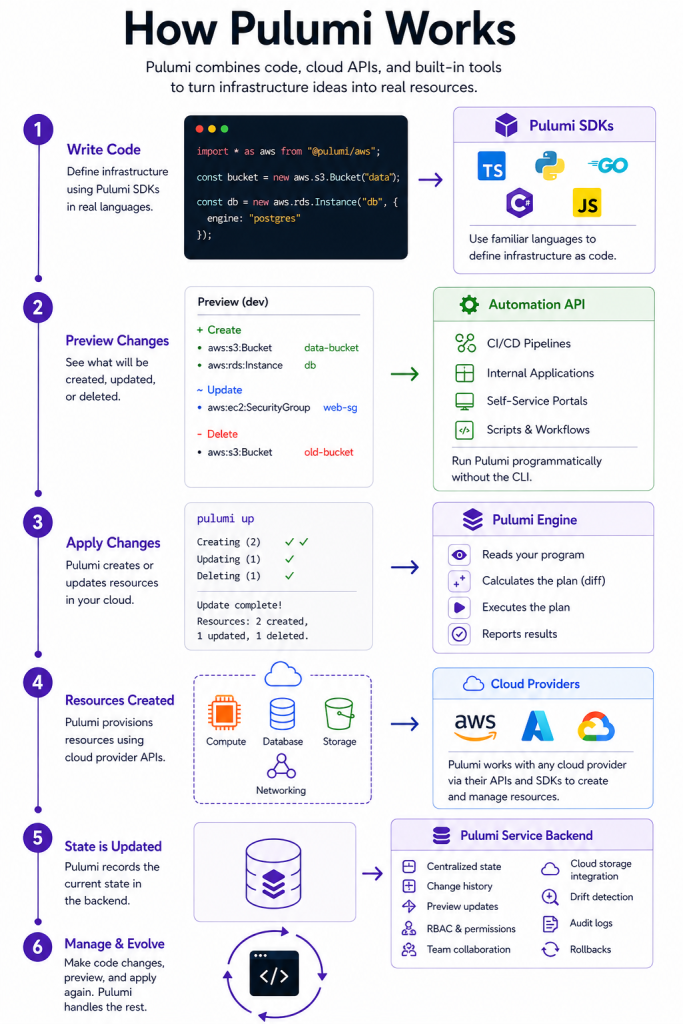
Pulumi combines code, cloud APIs, and built-in tools to turn infrastructure ideas into real resources. It uses several key components that handle everything from writing code to storing state and automating deployments, making the entire process easier to manage and scale.
Pulumi SDKs
Pulumi SDKs are libraries that let engineers define cloud infrastructure using real programming languages like Python, TypeScript, C#, Go, or Java. They provide ready-made classes and functions for creating and managing resources such as virtual machines, databases, storage, and networks. Instead of writing raw API calls, engineers use simple code that maps directly to cloud services, making their infrastructure easier to read, reuse, and maintain.
Pulumi Service Backend
The Pulumi Service Backend is where Pulumi stores and manages the state of the infrastructure. It keeps a record of resources, tracks changes over time, and shows previews of updates before they happen. It also supports team collaboration by allowing multiple users to work on the same project, view history, and manage deployments in a shared environment.
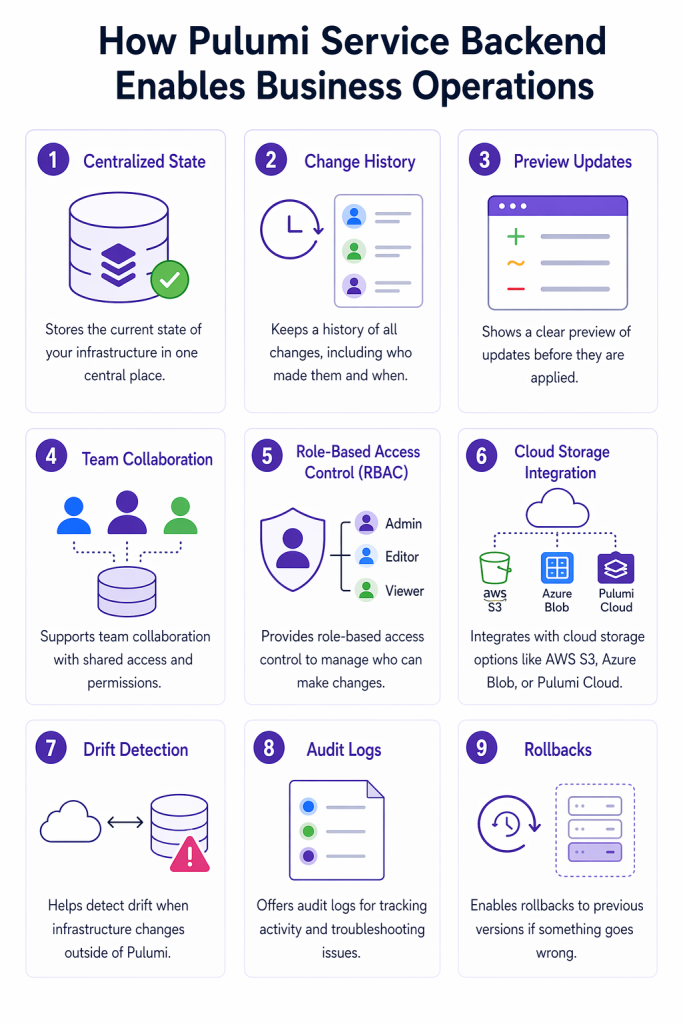
This is how the Pulumi Service Backend works:
- Centralized state. Stores infrastructure state in one managed location so teams always work from a consistent source of truth.
- Change history. Keeps a record of past infrastructure updates, helping teams review changes and troubleshoot issues.
- Preview updates. Shows proposed changes before deployment so teams can catch mistakes and reduce operational risk.
- Team collaboration. Allows multiple engineers to work on the same infrastructure projects with shared visibility and coordination.
- Role-based access control (RBAC). Role-based access control lets businesses limit permissions based on job responsibilities and security policies.
- Cloud storage integration. Connects with cloud storage services for managing state data in environments that require custom storage control.
- Drift detection. Identifies differences between deployed resources and the expected configuration, helping maintain compliance and stability.
- Audit logs. Tracks user actions and system events for governance, accountability, and security reviews.
- Rollbacks. Helps restore previous known-good infrastructure states when updates cause problems or failures.
The Pulumi Service Backend keeps the infrastructure state secure, organized, and easy to manage, helping teams work together and deploy changes with confidence.
Automation API
The Pulumi Automation API allows administrators to run Pulumi programmatically from your own applications or scripts. This means they can trigger infrastructure deployments without using the Pulumi CLI, which is useful for building custom workflows, self-service portals, or CI/CD pipelines. It gives them more control over how and when infrastructure is created or updated.
Learn more about the latest automation testing tools to make an informed decision for your software development process.
Pulumi Features
Pulumi offers a range of features that make it easier to build, manage, and scale infrastructure using code. These features enable administrators to do the following:
- Multi-language support. Write infrastructure using familiar languages like Python, TypeScript, Go, or C#, instead of learning a new syntax.
- Multi-cloud support. Manage resources across AWS, Azure, Google Cloud, and other providers from a single tool.
- Infrastructure as Code. Define and manage infrastructure in code, making setups repeatable and version-controlled.
- Preview and change tracking. See what changes will happen before applying them, reducing the risk of mistakes.
- State management. Keep track of infrastructure so updates are applied safely and consistently.
- Reusable components. Create modular and reusable infrastructure code to simplify large projects.
- Secrets management. Securely store and handle sensitive data like passwords and API keys.
- Automation API. Automate deployments through code, scripts, or CI/CD pipelines.
- Policy as code. Enforce rules and best practices automatically to maintain compliance and consistency.
- Drift detection. Identify changes made outside of Pulumi to keep infrastructure aligned with code.
These features enable more efficient infrastructure management, reduce manual work, and keep systems consistent as they grow.
Pulumi Benefits
Pulumi provides several benefits that make managing infrastructure easier, faster, and more reliable. By using real code and automation, it helps teams reduce errors, improve workflows, and scale systems with less effort.
Faster Development and Deployment
Pulumi helps engineers build and launch infrastructure faster by using code that can be quickly written and reused. Instead of setting things up by hand every time, they can automate the process and deploy changes in minutes, which is especially helpful for testing and scaling.
Use of Familiar Programming Languages
With Pulumi, developers do not need to learn a separate configuration language. They can use familiar languages such as Python, JavaScript, TypeScript, Go, C#, or Java, along with tools they already know, including PyCharm, Visual Studio Code, pip, npm, and Node.js. This helps teams get started faster and can reduce the learning curve compared with infrastructure tools that require a proprietary language.
Better Code Reusability
Pulumi lets developers reuse the same infrastructure code across multiple projects and environments. Teams can create shared components for common setups such as networks, security policies, or server configurations, then apply them wherever needed. This saves time, reduces duplicate work, and helps keep infrastructure consistent across deployments.
Improved Collaboration
Teams collaborate more effectively when infrastructure is defined as code and stored in version control systems such as GitHub or GitLab. Team members can review changes, track updates, and see who modified what. This makes it easier to coordinate work while maintaining stable and consistent environments.
Other collaboration benefits include:
• Clear change visibility. Teams can review proposed and completed changes in one shared place.
• Safer teamwork. Review workflows help catch errors before updates are deployed.
• Role-based access. Permissions are limited based on responsibilities.
• Audit and history tracking. Teams can trace when infrastructure was created, updated, or removed.
• Better communication. Shared workflows and documented changes reduce confusion.
These benefits help organizations move faster while keeping infrastructure reliable.
Reduced Errors and Safer Changes
Pulumi previews changes before applying them, so developers can see exactly what will happen. This helps catch mistakes early, avoid accidental deletions, and reduce the risk of downtime caused by misconfigurations.
Scalability and Flexibility
As systems grow, Pulumi helps teams update and scale infrastructure more efficiently. They can add new resources, modify configurations, and reuse existing code across environments without rebuilding everything from scratch. Pulumi also supports multiple cloud providers, making it easier to manage and expand infrastructure across different platforms.
Built-In Security Features
Pulumi includes features for managing secrets and enforcing policies, helping organizations protect sensitive data and keep infrastructure aligned with security requirements. This reduces the risk of exposing credentials, misconfiguring permissions, or making unsafe changes during deployments. It also provides stronger visibility and control over how infrastructure is managed.
Other useful security and governance features include:
• Secrets management.
• Encrypted state storage.
• Policy as code.
• Access control.
• Safe previews.
• Audit logs.
• Drift detection.
These features help teams build and manage infrastructure in a safer, more controlled, and more consistent way.
Automation and Integration
Pulumi integrates well with CI/CD pipelines and supports automation through its API. This allows developers to build custom workflows and automate infrastructure updates as part of the development process, improving efficiency and consistency.
Pulumi Challenges
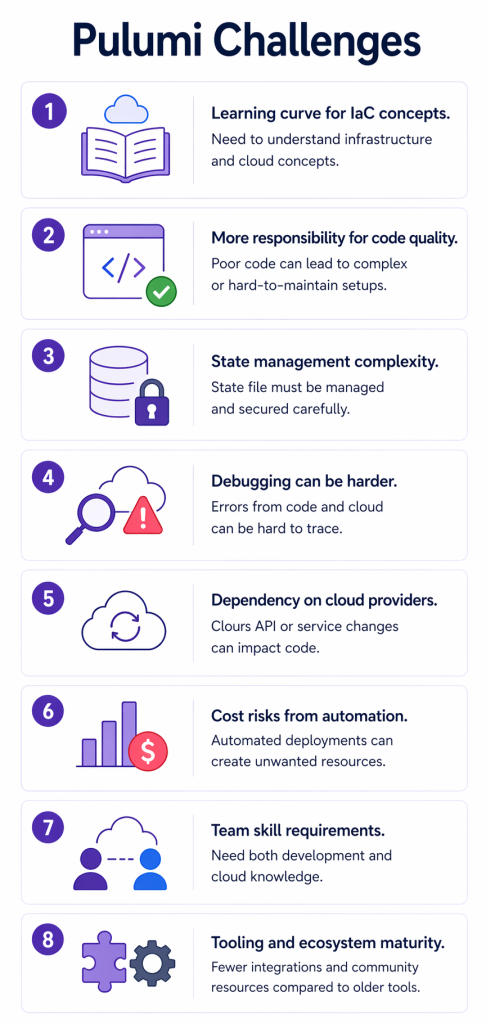
While Pulumi offers many benefits, it also comes with some challenges that teams should consider before using it. They include:
- Learning curve for IaC concepts. Even when using familiar programming languages, teams still need to understand networking, identity permissions, and cloud architecture.
- Greater responsibility for code quality. Because infrastructure is managed through code, weak coding standards create environments that are difficult to maintain or scale.
- State management complexity. State files must be secured and coordinated carefully, especially in shared team environments, to prevent conflicts or data loss.
- More complex troubleshooting. Problems may originate from application code, configuration logic, or the cloud provider, which makes it harder to identify root causes.
- Reliance on cloud providers. Changes to provider APIs, services, or features can impact how Pulumi deployments behave.
- Automation-related cost risks. If changes are not reviewed properly, automated deployments can unintentionally create unnecessary resources and increase spending.
- Broader skill requirements. Effective use of Pulumi often requires both software development experience and cloud infrastructure knowledge.
- Tooling and ecosystem maturity. Compared with longer-established IaC tools, some integrations, plugins, or community resources may be less mature.
Understanding these challenges helps organizations use Pulumi more effectively and avoid issues as the infrastructure grows.
Pulumi Use Cases
Pulumi can be used in many real-world scenarios where teams need to build, manage, and automate infrastructure. It helps simplify complex setups and makes systems easier to maintain as they grow.
Cloud Infrastructure Provisioning
Pulumi is commonly used to create and manage cloud resources like virtual machines, databases, storage, and networks. Instead of manual setups, code defines the entire environment. This makes it easy to spin up new environments, copy setups across regions, and keep everything consistent.
Multi-Cloud Management
If an organization uses more than one cloud provider, Pulumi lets it manage different cloud environments consistently from a single codebase. Resources such as AWS, Azure, and Google Cloud can be deployed using the same tools and workflows.
Other benefits of Pulumi in multi-cloud environments include:
- Reduced vendor lock-in.
- Simpler workflows and centralized management from a single dashboard.
- Easier scaling.
- Better cost control.
These benefits make it easier to manage complex, multi-cloud setups while keeping infrastructure flexible and efficient.
CI/CD and DevOps Automation
Pulumi fits well into CI/CD pipelines, where infrastructure needs to be created or updated automatically during deployments. For example, developers can spin up test environments for each code change and remove them when they are no longer needed. This speeds up development and reduces manual work.
Kubernetes and Container Management
Pulumi can manage Kubernetes clusters and the applications running on them. Developers can define clusters, deploy containers, and configure services all in one place. This makes it easier to manage modern, container-based applications.
Pulumi lets teams define both the Kubernetes clusters and the apps running on them in one place, including:
- Cluster provisioning. Create and manage Kubernetes clusters on supported cloud providers or platforms.
- App deployment. Deploy containers, services, and related resources using code.
- Unified workflow. Manage infrastructure and workloads through the same toolchain and deployment process.
- Configuration management. Handle settings, secrets, and environment-specific values consistently.
- Helm and YAML support. Use existing Helm charts or Kubernetes YAML manifests alongside Pulumi code.
These capabilities make Kubernetes environments easier to manage, scale, and automate.
Infrastructure Scaling and Updates
As the application grows, Pulumi helps to update and scale infrastructure safely. Engineers can change resource sizes, add new services, or update configurations by modifying code. Pulumi plans and applies those changes while managing dependencies between resources.
Policy and Compliance Enforcement
Pulumi allows platform and security teams to define rules that the infrastructure must follow, such as security controls, approved regions, cost limits, or naming standards. These policies are checked automatically during deployment, helping organizations stay compliant and avoid risky configurations.
Self-Service Infrastructure Portals
With the Automation API, Pulumi can power internal tools that let developers create infrastructure on demand. Instead of waiting for manual provisioning, users can create approved resources through a portal, form, or internal application while Pulumi handles deployment in the background.
Choosing the right IDE can make coding easier and help you stay organized. Our guides on Java IDE and Python IDE explain key features, ease of use, and how well they work with other tools.
Pulumi Stack Example
A Pulumi stack is an isolated instance of the same infrastructure project, typically used for a specific environment such as development, staging, or production. Each stack uses the same Pulumi program but has its own configuration values, state, and deployed resources.
For example, a team might use one stack for dev and another for prod, while reusing the same code with different settings such as instance size, region, or feature flags. When users run Pulumi, they select a stack, and Pulumi creates, updates, or manages resources for that environment based on the stack’s configuration.
This approach makes it easier to manage multiple environments, keep them consistent, separate changes safely, and scale operations as needs evolve.
Pulumi and phoenixNAP
When combined with phoenixNAP Bare Metal Cloud, Pulumi helps organizations build scalable, high-performance systems on dedicated hardware. Teams can automate server deployments, manage development and production environments, and integrate infrastructure changes into CI/CD workflows. The result is infrastructure that delivers bare metal performance while remaining easier to manage, faster to deploy, and more cost-efficient at scale.
Get started with BMC and Pulumi today! For more information and resources, refer to our GitHub Pulumi page.
Pulumi Alternatives
There are several tools similar to Pulumi that help manage infrastructure using code:
- Terraform. Uses its own configuration language (HCL) to define infrastructure. It is widely used, supports many cloud providers, and has a large community.
- AWS CloudFormation. A native AWS tool that defines infrastructure using JSON or YAML templates. It works well for organizations fully focused on AWS.
- Ansible. Focuses more on configuration management and automation using simple YAML playbooks. It can also handle infrastructure tasks.
- Chef. Uses Ruby-based scripts to automate infrastructure configuration and application deployment, often used in large enterprise environments.
- Puppet. A configuration management tool that ensures systems stay in the desired state over time using declarative code.
- Google Cloud Deployment Manager. A Google Cloud-native service that uses YAML or Python to define and deploy resources within GCP.
- Azure Resource Manager (ARM Templates). Microsoft’s built-in IaC solution for Azure. It uses JSON templates to deploy and manage Azure resources.
Each of these alternatives offers a different way to manage infrastructure, so the right choice depends on your team’s skills, preferred tools, and the cloud platforms you use.
Simplifying Infrastructure Management with Pulumi
Pulumi makes it easier to manage infrastructure by letting you use simple code instead of manual setup. It helps you build, update, and fix your systems faster while avoiding common mistakes. With Pulumi, you can keep everything organized and make changes with confidence as your projects grow.