Running an in-house data center demands constant investment in hardware, staffing, and maintenance. Many IT teams struggle to control infrastructure costs while still meeting growing performance and uptime demands.
Cloud computing offers a way out of this cycle by shifting infrastructure management to a third-party provider.
This article explains the advantages and disadvantages of cloud computing to help you decide whether the model fits your organization.
Cloud Advantages and Disadvantages: An Overview
Every benefit of cloud computing comes with a corresponding downside. The table below summarizes the main points:
| Aspect | Advantage | Disadvantage |
| Cost | Pay only for the resources you use. | Costs can grow unpredictably at scale, and vendor lock-in limits switching later. |
| Scalability | Resources scale up or down within minutes. | Poorly managed auto-scaling spikes bills. |
| Maintenance | The provider handles updates and patching. | Teams have less control over update timing. |
| Security | Providers invest heavily in security tooling. | The shared responsibility model creates security gaps. |
| Accessibility | Data and apps are available from anywhere. | Performance depends on a stable internet connection. |
| Reliability | Redundant infrastructure reduces downtime. | An outage on the provider's side affects every tenant. |
We will explore the most important pros and cons of cloud computing in more detail below.
Advantages of Cloud Computing
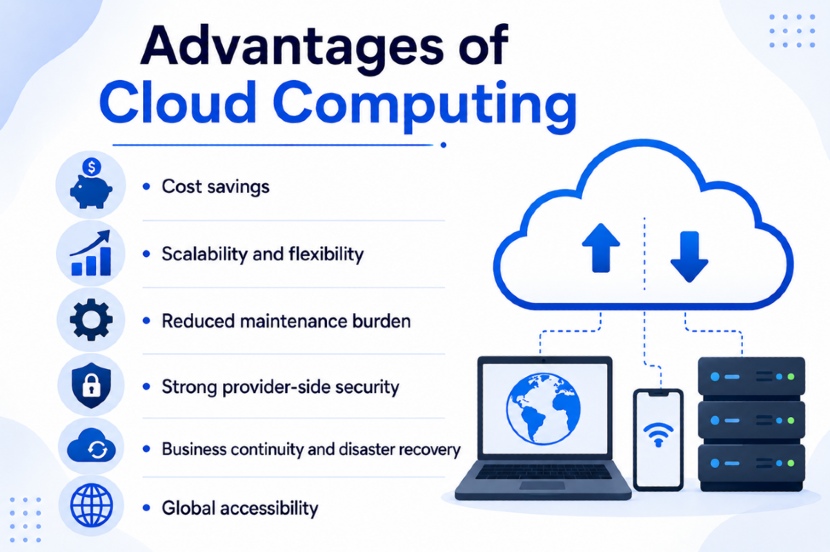
Cloud computing solves several of the most persistent problems in traditional IT. From cost control to disaster recovery, each advantage addresses a specific operational bottleneck. The sections below cover the benefits that matter most to growing businesses.
Cost Savings
Cloud providers replace large upfront hardware purchases with predictable, usage-based billing. Teams no longer need to guess future capacity needs years in advance.
This pricing model reduces several cost categories at once:
- Capital expenditure (CapEx). No large purchases for servers, racks, or cooling systems.
- Staffing. Fewer engineers are needed to rack, patch, and repair physical hardware.
- Utilities. The provider absorbs power and cooling costs for shared infrastructure.
- Idle capacity. Pay-as-you-go pricing avoids paying for hardware that sits unused.
These savings free up budget for teams to reinvest in product development instead of infrastructure upkeep.
Scalability and Flexibility
A cloud environment adjusts capacity to match real demand instead of forcing a fixed footprint. Resources scale up during traffic spikes and scale back down once demand fades.
This flexibility supports several common business scenarios:
- Seasonal traffic. Retail sites handle holiday spikes without owning idle servers year-round.
- Product launches. New apps scale instantly if they gain sudden popularity.
- Global expansion. Teams deploy resources in new regions within minutes.
- Testing environments. Developers spin up and tear down test infrastructure on demand.
This elasticity lets businesses respond to opportunities without waiting on procurement cycles.
Reduced Maintenance Burden
The cloud provider owns the physical hardware, so patching, replacing, and monitoring that hardware becomes their responsibility. Internal IT teams shift their focus from upkeep to strategy.
Providers often manage the following tasks on the customer's behalf:
- Hardware replacement. Failed drives, memory, and network gear get swapped without customer involvement.
- Firmware and OS patching. Security patches roll out on a regular, provider-managed schedule.
- Physical security. Data center access controls and surveillance are built into the service.
- Capacity planning. The provider maintains enough headroom to absorb demand across all tenants.
This division of labor lets internal teams spend more time on application development instead of infrastructure repairs.
Strong Provider-Side Security
Cloud providers invest heavily in security measures that most individual businesses cannot replicate on their own. This shared infrastructure benefits from expertise and tooling built at a much larger scale.
Providers deliver the following security capabilities as part of the service:
- Physical security. Data centers use biometric access controls, surveillance, and on-site staff.
- Network protection. Built-in firewalls, DDoS mitigation, and traffic monitoring guard the infrastructure layer.
- Compliance certifications. Providers maintain standards like ISO 27001, SOC 2, and PCI DSS on the customer's behalf.
- Threat intelligence. Large providers detect and respond to emerging threats faster than most in-house teams.
This foundation gives businesses a stronger security baseline than most could afford to build alone. Customers still own their share of the responsibility under the shared responsibility model.
Business Continuity and Disaster Recovery
Cloud providers make it easy to replicate data across multiple availability zones and, with additional configuration, across regions. This redundancy gives businesses a stronger recovery position than most single-site data centers.
A solid cloud-based continuity plan includes the following:
- Automated backups. Data snapshots run on a schedule without manual intervention.
- Geographic redundancy. Copies of critical data exist in physically separate locations.
- Failover automation. Traffic reroutes to a healthy region if one site goes down.
- Rapid restoration. Recovery point and recovery time objectives shrink compared to on-premises setups.
Built-in redundancy turns disaster recovery from a costly side project into a standard feature of the platform.
Global Accessibility
Cloud-hosted applications and data are reachable from any device with an internet connection. This accessibility supports distributed teams and customers without extra infrastructure.
Common benefits of this always-on accessibility include:
- Remote work. Employees access company systems from home or while traveling.
- Cross-team collaboration. Teams in different offices work from a single shared environment.
- Customer reach. Applications serve users across regions without local infrastructure.
- Mobile access. Apps built for the cloud extend naturally to mobile devices.
This reach makes the cloud a practical foundation for any business with a distributed workforce or customer base.
If you are still deciding between hosting models, read our comparison of on-premises vs. cloud computing for a deeper look at the pros and cons of each solution.
Disadvantages of Cloud Computing
Cloud computing is not free of risk. Some of these downsides are unavoidable, while others stem from poor planning or misconfiguration. The sections below cover the disadvantages that teams need to plan around before migrating.
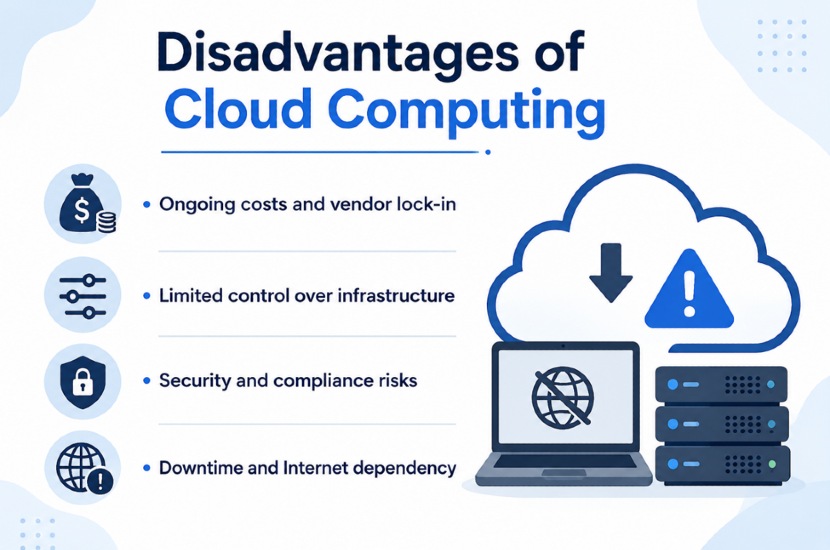
Ongoing Costs and Vendor Lock-in
Usage-based pricing can outpace the cost of owned hardware once workloads grow large and steady. Migrating away from a provider afterward can present technical and financial challenges.
Watch for the following cost and lock-in risks:
- Unpredictable bills. Traffic spikes or misconfigured resources drive costs up fast.
- Runaway auto-scaling. A loose scaling policy can spin up far more capacity than a workload needs.
- Proprietary services. Provider-specific tools make workloads harder to move elsewhere.
- Data egress fees. Some providers charge extra to transfer data out of their platform.
- Long-term contracts. Reserved pricing plans often lock a business into a single vendor.
A clear cost monitoring and exit strategy helps businesses avoid surprises tied to cloud use. Budget alerts, resource tagging, and regular usage reviews turn that strategy into daily practice rather than a one-time plan.
Limited Control Over Infrastructure
Customers share physical infrastructure with other tenants and depend on the provider's roadmap. This setup limits how much a business can customize its environment, including how and when maintenance happens.
Common control limitations include:
- Fixed hardware options. Customers choose from a provider's available instance types only.
- Shared resource pools. Multi-tenant environments limit deep hardware-level customization.
- Update timing. Providers set their own patch and maintenance schedules. This often triggers unplanned reboots or brief service interruptions outside a business's preferred change windows.
- Forced upgrades. Providers eventually retire older service versions, forcing customers to migrate on the provider's timeline rather than their own.
- Regional availability. Provider data centers may not exist in every region a business requires.
Businesses with highly specific hardware or compliance needs often find these limits restrictive. The convenience of offloading maintenance also means giving up a say in when it happens.
Security and Compliance Risks
Cloud security follows a shared responsibility model: the provider secures the infrastructure, while the customer secures data, access, and configurations. Misunderstanding that split creates gaps.
Frequent sources of cloud security risk include:
- Misconfigured storage. Publicly exposed buckets remain a leading cause of data leaks.
- Weak access controls. Overly broad permissions expand the attack surface.
- Compliance gaps. Providers lacking specific certifications expose regulated workloads to penalties.
- Multi-tenancy exposure. A vulnerability in shared infrastructure often affects multiple customers.
Verify each of these controls before migration, because retrofitting them after workloads go live costs far more.
Cloud security is a shared effort between you and your provider. Read our guide to cloud security best practices to understand exactly where your responsibilities begin.
Downtime and Internet Dependency
Cloud services depend entirely on a stable internet connection and the provider's uptime. Any connectivity issue on either side interrupts access to critical systems.
Key dependency risks include:
- Provider outages. A regional outage can affect every customer hosted there at once.
- Local connectivity. A poor internet connection blocks access regardless of provider uptime.
- Bandwidth limits. Data-heavy workloads often hit throughput constraints during peak hours.
- Latency. Distance from the nearest data center adds delay for latency-sensitive apps.
Businesses running mission-critical systems need a documented plan for mitigating these risks.
Weighing Cloud Pros and Cons: When to Choose the Cloud
Cloud advantages and disadvantages affect organizations in different ways. The right call depends less on the technology itself and more on your workload, budget, and compliance needs. The following use cases show where each side of the equation tends to win.
Where Cloud Advantages Win: Ideal Use Cases
Businesses with variable workloads, distributed teams, or fast growth get the most value from cloud computing. In these cases, the advantages of cloud computing outweigh the disadvantages by a wide margin.
Cloud computing fits well in the following scenarios:
- Startups and small businesses. Low upfront costs support growth without a large IT budget.
- Seasonal or unpredictable traffic. Elastic scaling handles demand spikes automatically.
- Distributed or remote teams. Global accessibility keeps everyone connected to the same systems.
- Rapid development cycles. Fast provisioning supports frequent testing and deployment.
These scenarios highlight why the advantages of cloud computing continue to drive adoption across industries.
Where Cloud Disadvantages Prevail: Who Should Avoid Cloud
Some organizations face requirements that the cloud model struggles to meet. In these cases, the disadvantages of cloud computing outweigh the convenience it offers.
Consider an alternative to the public cloud if your organization fits one of these profiles:
- Heavily regulated industries. Frameworks like HIPAA or GDPR impose strict requirements on data handling, access, and location that some cloud providers may not fully support.
- Latency-sensitive workloads. Real-time applications need infrastructure physically close to end users.
- Predictable, steady-state workloads. Owned hardware can cost less than pay-as-you-go pricing over time.
- Highly customized hardware needs. Specialized processing requirements often exceed standard cloud instance options.
Private cloud and on-premises infrastructure often address these constraints more directly than public cloud deployment. Hybrid cloud offers a middle ground for businesses that do not fit neatly into either category, keeping sensitive workloads on-premises while running everything else in the public cloud.
If your organization needs more control than the public cloud allows, explore phoenixNAP's Managed Private Cloud for a dedicated environment with expert management.
Cloud Computing: A Decision Worth Making Deliberately
Cloud computing offers real advantages in cost, scalability, and accessibility. However, those benefits come with downsides in control, security, and long-term pricing. The right choice depends on workload patterns, compliance needs, and growth plans. Review your current infrastructure against the use cases above and choose the model that supports your goals.