Data centers use continuous deployment mechanisms to spin up thousands of servers simultaneously. For decades, the Preboot Execution Environment (PXE) served as the standard network booting mechanism.
However, traditional PXE has architectural limitations that restrict modern, large-scale deployment. This guide examines iPXE, the open-source network boot firmware that replaces legacy PXE, providing advanced networking, security, and scripting capabilities at the pre-boot stage.
What Is iPXE?
iPXE is a customizable, open-source network boot firmware implementation. It is a direct drop-in replacement for traditional PXE ROMs, enabling hardware initialization and network configuration before the operating system takes control.
The diagram below illustrates how iPXE acts as middleware, introducing advanced networking and automation before an operating system is loaded into the server's memory.
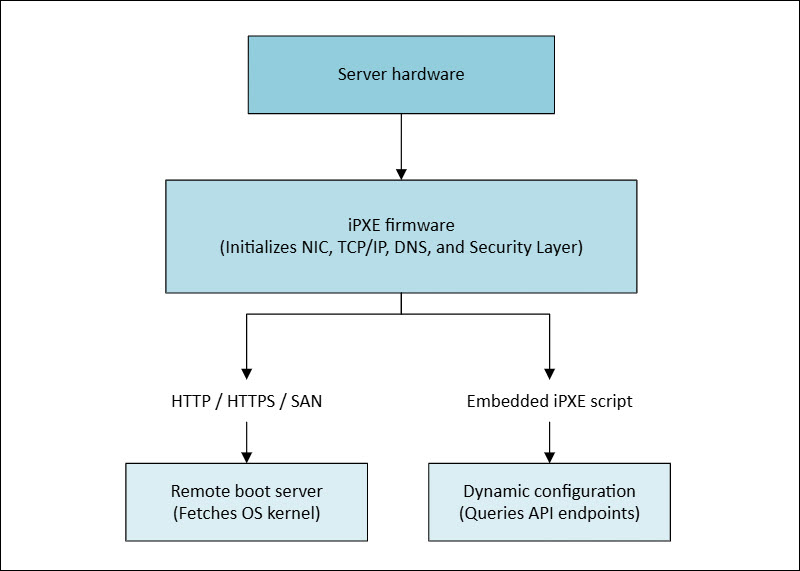
The Server Hardware (CPU, motherboard, and Network Interface Controller (NIC)) executes its initial Power-On Self-Test (POST). Instead of looking for a local hard drive or a primitive legacy PXE environment, the system hands control over to iPXE.
Next, iPXE initializes the NIC and builds a full software network stack inside the system's volatile memory. With network connectivity established, iPXE can execute its logic in two ways, which often work together:
- Embedded iPXE script. Instead of waiting for a static network command, iPXE runs a pre-compiled or dynamically fetched script. It queries internal assets (such as the server's asset tag or MAC address) and sends a request to a local or cloud-based API endpoint (Dynamic Configuration). The API responds with real-time, machine-specific instructions.
- HTTP / HTTPS / SAN. iPXE bypasses slow legacy protocols like Trivial File Transfer Protocol (TFTP). It establishes a secure, high-speed connection over HTTP, HTTPS, or storage protocols (like iSCSI or FCoE SANs) directly to a remote boot server.
Traditional PXE vs. iPXE
Traditional PXE relies on a combination of TFTP and Dynamic Host Configuration Protocol (DHCP). These legacy protocols limit transmission speeds, lack security verification mechanisms, and restrict cross-subnet communication.
| Traditional PXE | iPXE | |
|---|---|---|
| Primary transport protocols | TFTP | HTTP, HTTPS, FTP, TFTP |
| Storage Area Network (SAN) boot | Not Supported | iSCSI, FCoE, AoE |
| Scripting capabilities | None (Static Configuration) | Dynamic Scripting Language |
| Network medium | Wired Ethernet Only | Wired, Wi-Fi, Wide Area Network (WAN) |
| Cryptographic security | None | TLS Certificates, Cryptographic Signatures |
TFTP operates over User Datagram Protocol (UDP), which requires individual packet acknowledgments, stalling data transfers over high-latency networks. Conversely, iPXE supports full Transmission Control Protocol (TCP) stacks that allow fast image delivery via HTTP and HTTPS.
Additionally, standard PXE cannot cross local routing boundaries without complex DHCP relay agents, whereas iPXE resolves domain names via Domain Name System (DNS) to fetch payloads across global networks.
Because TFTP uses small block sizes (typically 512-1468 bytes), downloading a modern Linux kernel and initial RAM disk (initrd) can take a significant amount of time. Under iPXE, the HTTP client utilizes TCP window scaling, enabling the network card to saturate available network bandwidth.
Why Modern Data Centers Require iPXE Firmware Booting?
Modern data centers scale rapidly, demanding infrastructure deployment pipelines that parallel public cloud instances. Legacy methods often fail when engineers must deploy operating systems across hundreds of geographical regions simultaneously.
Hyperscale operators require a pre-boot environment that interacts directly with configuration management databases and web APIs. iPXE satisfies this requirement by executing dynamic startup scripts that read unique system identifiers like Media Access Control (MAC) addresses, system serial numbers, or asset tags. It performs the following actions:
- Transmits variables to a centralized provisioning engine.
- Obtains tailored instructions.
- Installs the target operating system without manual intervention or localized installation media.
Traditional PXE broadcasting leaks lease information and provisioning requests across the local broadcast domain, presenting a severe isolation risk. iPXE limits exposure by shifting the discovery phase away from localized network broadcasts toward targeted, encrypted web requests sent directly to authorized orchestration control planes.
iPXE and Bare Metal Cloud Integration by phoenixNAP
Integrating iPXE with the phoenixNAP Bare Metal Cloud (BMC) ecosystem allows users to bypass standardized operating system blueprints entirely. Developers can specify a target web URL that contains a custom iPXE boot script either directly through the BMC portal or via POST requests to the automated provisioning API endpoint.
Once initial setup is performed, BMC performs the following actions:
- Instantiates the physical node.
- Configures native public or private VLANs with static DHCP addresses.
- Instructs the network interface cards to stream and execute unique software packages or customized OS kernels from secure external repositories.
This native integration supports various enterprise use cases while maintaining unconstrained environments. Organizations can choose to keep the instance running as a continuously mutable iPXE server or transition it to a permanent operating system after installation.
To maximize network reliability in production, the infrastructure delivers instances on high-performance dual network interfaces. To establish network redundancy and ensure continuous failover protection, system administrators can configure Link Aggregation Control Protocol (LACP) following server deployment.
Note: For more information on how to use iPXE on BMC, read How to Use iPXE on Bare Metal Cloud.
Business Benefits of iPXE
Enterprise engineering infrastructure demands high efficiency and security with low operational overhead. Incorporating iPXE into the core provisioning architecture yields many advantages throughout the bare-metal management lifecycle.
Organizations transition away from hardware-bound installation media to achieve significant cost reductions and security improvements. The sections below break down the specific business outcomes driven by iPXE.
Accelerating Time-to-Market with Zero-Touch Provisioning
Zero-touch provisioning reduces the time required to bring new server compute capacity online.
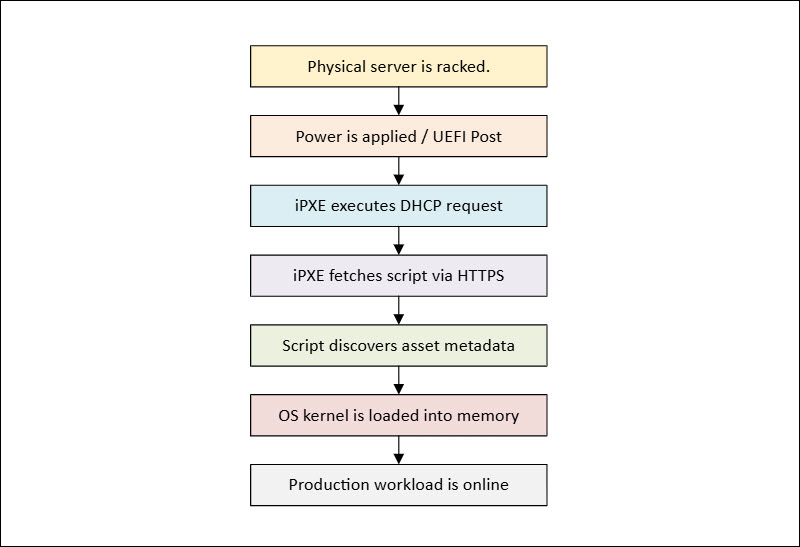
Infrastructure teams deploy new nodes by racking the physical hardware and connecting the network cables. Upon power delivery, iPXE performs the following steps:
- Initialization.
- Contacting the provisioning API.
- Pulling the designated operating system image.
- Executing the installation configuration.
This continuous automation pipeline eliminates manual configuration errors, driving commissioning times from days down to minutes. The steps of the pipeline are shown in the diagram below.
When sudden traffic spikes threaten service availability, automated provisioning engines scale physical compute resources horizontally in near real time. This feature eliminates the need to maintain massive pools of expensive, idle, pre-installed standby servers, as bare metal transitions to an active state on demand.
Lowering Data Center TCO
Data center Total Cost of Ownership (TCO) drops when infrastructure teams eliminate complex, localized deployment architectures. Legacy network booting requires the widespread deployment of local TFTP servers to prevent cross-subnet performance bottlenecks.
Because iPXE uses standard HTTP and HTTPS, administrators place boot resources behind standard load balancers and Content Delivery Networks (CDNs). This structural efficiency reduces the infrastructure footprint required for system maintenance, lowering hardware costs, licensing fees, and administration overhead.
By switching to HTTP-based delivery, organizations eliminate the need for specialized storage arrays dedicated to installation images at every edge location. Centralizing these images onto a single, highly available web cluster minimizes storage duplication. The reduction in localized compute dependencies lowers power consumption and cooling costs across the entire data center portfolio.
Mitigating Human Error
Manual configuration introduces human error into enterprise deployment pipelines, leading to production configuration drift. By utilizing centralized, programmatic scripting at the pre-boot level, iPXE enforces identical configuration baselines across all hardware nodes.
Every target system executes deterministic code blocks that govern asset discovery, firmware flashes, and disk partitioning schemes. Strict automation eliminates typos, missed settings, and non-standard installations.
Eliminating Vendor Lock-In
Proprietary deployment appliances lock organizations into specific hardware ecosystems and expensive software subscription models. iPXE is an open-source, vendor-agnostic framework that operates consistently across hardware platforms.
The software abstracts the underlying network controller variations, presenting a unified interface, whether deploying onto Dell, HPE, or generic whitebox Original Design Manufacturer (ODM) servers. Companies retain complete freedom to source hardware from competitive vendors based on price and component availability.
The abstraction layer standardizes the developer interface. System architects write a single set of installation scripts that run on any hardware architecture with an iPXE-compatible network card.
Hardening Infrastructure Security at the Pre-Boot Level
Unencrypted pre-boot network communication exposes infrastructure to man-in-the-middle attacks and malicious payload injection. Traditional PXE downloads unauthenticated binaries, risking rootkit installation during initialization.
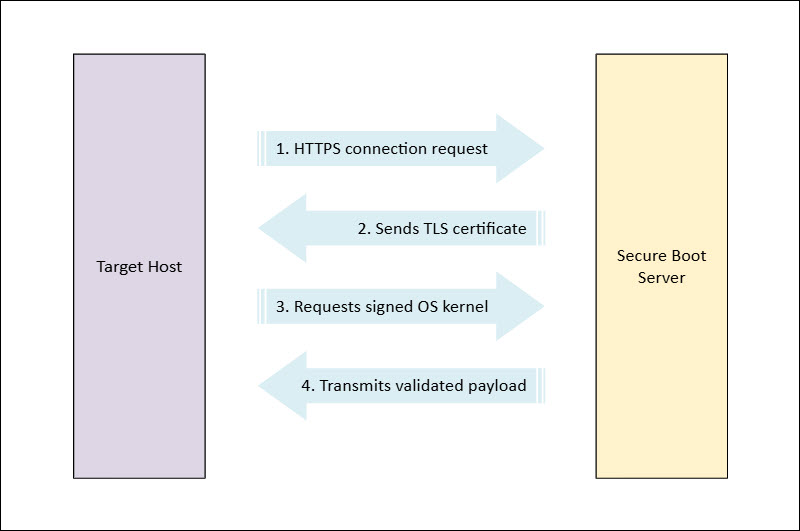
iPXE prevents these threat vectors by embedding Transport Layer Security (TLS) certificates directly into the firmware image. As illustrated in the diagram below, servers validate the boot server's cryptographic identity before pulling OS kernels, thereby guaranteeing code integrity.
In high-security environments, passing cleartext data over local area networks violates regulatory compliance standards. Because iPXE handles standard web certificates, data center teams encrypt the entire deployment path, satisfying compliance parameters before the kernel begins loading into memory. This eliminates a major blind spot in zero-trust architecture frameworks.
Hardware Utilization and Resource Elasticity
Fixed storage architectures limit infrastructure agility by tying server identities to localized physical disks. iPXE enables diskless booting, where servers run operating systems from remote Storage Area Networks (SANs).
This design allows administrators to reallocate compute resources in response to variable workloads. A server running a web server during peak daytime traffic can reboot via iPXE at night to mount a high-performance computing image, maximizing hardware utilization.
Diskless architectures change hardware maintenance paradigms. If a motherboard fails, technicians move the network identity and SAN mappings to an identical standby node without moving physical disks or executing time-consuming disk cloning operations. The computing node becomes stateless, transforming bare metal into a disposable and replaceable utility resource.
Core Capabilities of iPXE
The technical design of iPXE introduces features previously found only in mature operating system kernels. These core capabilities give the firmware flexibility throughout the pre-boot cycle.
By providing native support for complex protocols and script parsing, iPXE bridges the gap between hardware initialization and high-level automation platforms. Below are the core technical mechanisms driving this solution.
HTTP/HTTPS
Traditional PXE relies on TFTP, which operates over UDP. Because UDP lacks native flow control, TFTP implements its own strict stop-and-wait architecture at the application layer, as illustrated below:
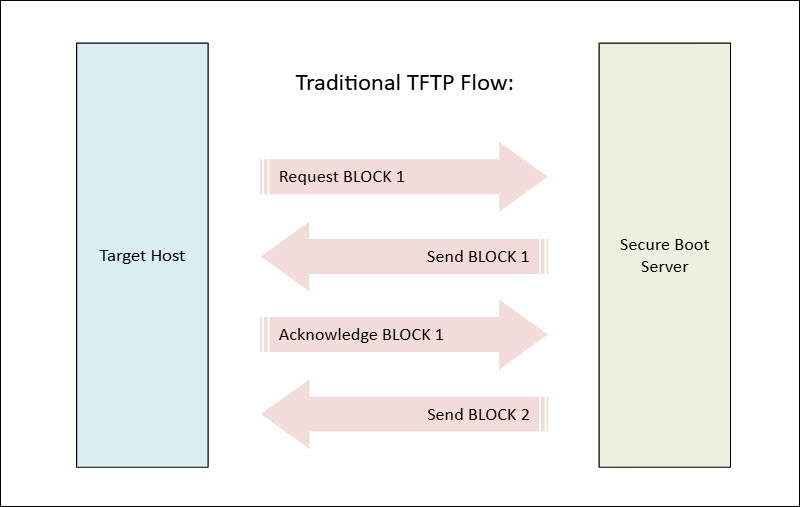
iPXE introduces a full TCP stack into the pre-boot environment, allowing it to leverage standard HTTP/HTTPS web servers.
Instead of waiting for an acknowledgment for each packet, the underlying TCP protocol uses a sliding window. The server sends a continuous stream of packets onto the wire simultaneously. The host acknowledges these packets in bulk while the server keeps pushing data, latency no longer stalling the transmission:
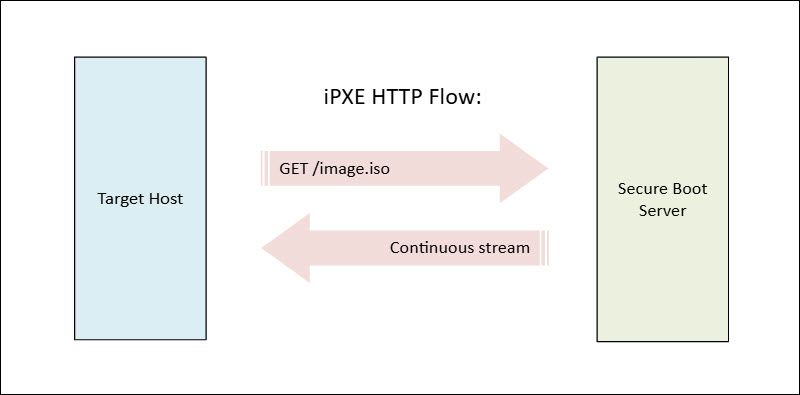
Boot image delivery speeds increase exponentially, allowing multi-gigabyte operating system images to transfer across the network at line rate. HTTPS integration ensures encryption of sensitive deployment data, shielding passwords, configuration variables, and intellectual property from local network sniffing.
The incorporation of HTTP also enables standard web architecture optimizations. Systems leverage HTTP redirect statuses (such as 302) to dynamically balance server load. If a primary boot mirror experiences high utilization, the upstream load balancer routes incoming iPXE clients to an underutilized secondary storage node.
Dynamic Scripting
The internal command-line interpreter of iPXE executes interactive scripts during initialization. These scripts use standard programming constructs, including loops, conditional statements, variable assignments, and error-handling routines.
An iPXE script can query a target web API, pass the unique system UUID as a parameter, and dynamically parse the returned text file to alter execution paths. If a network download fails, the script catches the failure and diverts execution to a redundant backup server.
WAN/Wireless Booting
Unlike traditional PXE, which requires a wired local area network connection, iPXE operates across wide-area networks and wireless topologies. The firmware includes built-in drivers for various wireless network chipsets, enabling authenticated connections to secure Wi-Fi networks before system loading.
This capability allows remote edge locations, IoT gateways, and isolated field machinery to boot securely over internet-facing connections. System administrators manage updates from a centralized core infrastructure without local deployment servers.
For instance, a remote retail kiosk experiencing local drive corruption boots directly from an internet-accessible corporate repository. The device establishes a secure connection, pulls down a fresh, validated recovery image, and restores operational status without requiring an on-site field technician.
SAN Integration
Native storage protocol drivers allow iPXE to attach to remote storage blocks seamlessly. The firmware supports:
- Internet Small Computer Systems Interface (iSCSI).
- Fiber Channel over Ethernet (FCoE).
- AoE (ATA over Ethernet).
During initialization, iPXE connects to the target storage array and registers the remote block storage as a standard local disk drive. The subsequent operating system installer sees this network-attached volume as a local block device, installing and booting without local physical drives.
This architecture protects data persistence. Since the physical compute container holds no persistent state, hardware component failures do not risk data loss. The block storage infrastructure handles snapshot operations, data replication, and backups transparently, completely decoupled from the computing hardware processing the active application layer.
Universal Compatibility
The architecture of iPXE accommodates both legacy x86 BIOS environments and modern 64-bit UEFI deployments. It runs on standard architectures, including x86, x86-64, and ARM64 platforms.
Administrators compile iPXE as an option ROM, an independent executable, or a chainloaded payload from an existing PXE environment. This universal nature guarantees consistent operational workflows across legacy systems and cutting-edge server architectures.
Chainloading provides a non-destructive modernization solution. Organizations avoid flashing firmware on thousands of legacy network cards by configuring their existing, primitive PXE servers to deliver the iPXE binary as its initial payload. Once loaded into RAM, iPXE takes control of the hardware network interface, instantly unlocking HTTPS, scripting, and SAN features on old hardware configurations.
Cryptographic Verification
Enterprise environments must enforce strict security guidelines to verify software authenticity prior to execution. iPXE integrates cryptographic hash algorithms and public-key infrastructure (PKI) frameworks.
The firmware evaluates cryptographic signatures on downloaded kernels and initial ramdisks against embedded trusted root certificates. If a signature fails validation, indicating data corruption or unauthorized tampering, iPXE halts execution, protecting the node from compromised software.
The procedure is illustrated in the following diagram:
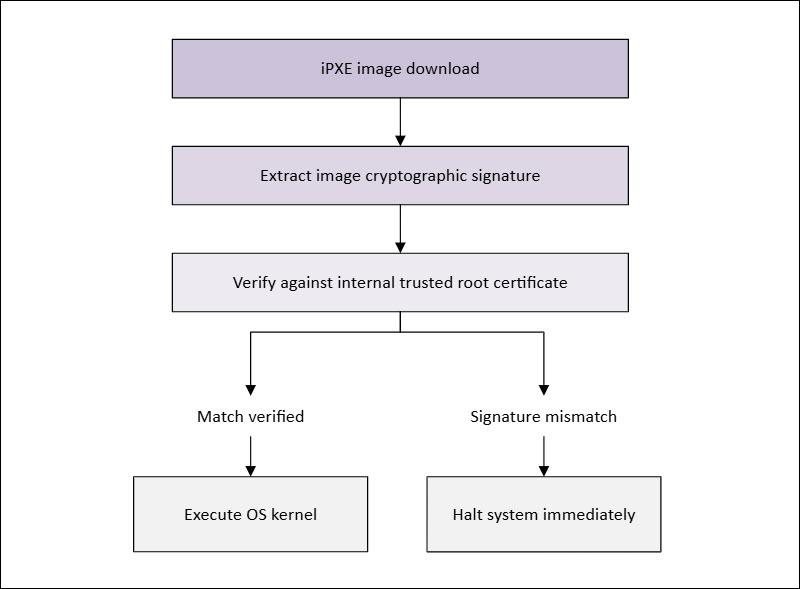
This security mechanism extends the chain of trust established by hardware secure boot. By embedding specific public keys directly into the compiled iPXE binary, operators ensure that the machine boots only operating systems verified by the central security office. This prevents insider threats and physical network manipulation attempts within the data center.
Why Is iPXE the Answer to Legacy Network Booting Limitations?
The evolution of automated server provisioning requires a modern alternative to the limitations of legacy network booting. iPXE delivers this advancement by providing a secure, scriptable, and fast pre-boot execution environment.
By introducing native support for HTTP, HTTPS, dynamic scripting, and Storage Area Network integration, this open-source firmware changes infrastructure lifecycle management. Implementing iPXE reduces operational overhead, enforces strict zero-trust security postures, and optimizes resource utilization across modern global data centers.
As operations scale to massive multi-site installations and edge computing environments, iPXE helps build predictable, automated, and secure bare-metal foundations and is an essential part of any related IT strategy plan.