As organizations expand across multiple locations and rely more heavily on cloud applications, traditional WAN architecture often struggles to provide the performance, flexibility, and visibility modern networks require. Challenges such as unpredictable application performance, complex network management, and rising connectivity costs can impact both productivity and user experience.
Software-Defined Wide Area Networking (SD-WAN) addresses these issues by intelligently managing network traffic, optimizing application performance, and simplifying connectivity across distributed environments.
This article explores what SD-WAN is, how it works, and its key benefits for organizations.
What Is SD-WAN?
Software-Defined Wide Area Networking (SD-WAN) is a network architecture that uses software-based controls to manage, optimize, and secure connections between geographically distributed sites, data centers, cloud platforms, and remote users across a wide area network (WAN).
Unlike traditional WAN solutions that primarily rely on dedicated multi-protocol label switching (MPLS) circuits and manual configuration, SD-WAN centralizes network management and dynamically directs traffic across multiple connection types (e.g., broadband internet, fiber, LTE, 5G, and MPLS) based on real-time network conditions and application requirements. As a result, it automatically selects the most suitable path for each workload to maintain consistent performance and maximize efficiency.
The technology also provides centralized visibility, policy-based traffic management, enhanced security capabilities, and simplified administration, making it easier for organizations to support cloud adoption, hybrid work environments, and modern distributed infrastructures.
Note: SD-WAN is often used as the networking foundation for distributed cloud environments. For a deeper look at how applications and workloads are deployed across multiple cloud locations, see our guide on Distributed Cloud.
SD-WAN vs. Traditional WAN
The primary difference between SD-WAN and traditional WAN lies in how network traffic is managed and optimized.
Traditional WAN architecture typically relies on dedicated MPLS connections and hardware-centric configurations, requiring network administrators to manually provision and manage routing between locations. While reliable, this approach can be expensive, less flexible, and slower to adapt to changing network demands.
SD-WAN, in contrast, uses software-defined controls and centralized management to dynamically route traffic across multiple connection types, including broadband internet, MPLS, LTE, and 5G. Continuously evaluating network conditions enables SD-WAN to automatically select the most efficient path for each application, improving performance, reducing costs, simplifying administration, and providing greater visibility into network activity across distributed environments.
The following table presents key differences between SD-WAN and traditional WAN:
| Feature | SD-WAN | Traditional WAN |
| Architecture | Software-defined and centrally managed. | Hardware-centric and manually managed. |
| Connectivity | Supports multiple connection types, including broadband, MPLS, LTE, and 5G. | Primarily relies on dedicated MPLS circuits. |
| Traffic Management | Dynamically routes traffic based on real-time network conditions and application needs. | Uses predefined routes with limited adaptability. |
| Network Visibility | Provides centralized monitoring and detailed traffic insights. | Offers limited visibility across the network. |
| Deployment and Management | Simplifies configuration and policy management through a central controller. | Requires device-by-device configuration and management. |
| Scalability | Easily adapts to new locations, users, and cloud services. | Scaling often requires additional hardware and manual provisioning. |
| Performance Optimization | Continuously optimizes traffic paths to improve application performance. | Performance depends largely on fixed network design. |
| Cost | Can reduce connectivity costs by leveraging internet-based links. | Often involves higher costs due to reliance on private circuits. |
| Cloud Readiness | Designed to support cloud and hybrid environments. | Originally built for data center-centric networking. |
| Security | Commonly includes integrated security and policy enforcement features. | Security is often provided through separate solutions. |
SD-WAN vs. MPLS
SD-WAN and MPLS both connect geographically dispersed locations, but they differ in how they manage network traffic and connectivity.
MPLS is a private networking technology that routes traffic over dedicated, provider-managed circuits, offering predictable performance and reliability, though often at a higher cost and with less flexibility. SD-WAN, on the other hand, is an overlay technology that uses multiple connection types, including broadband internet, MPLS, fiber, LTE, and 5G, to intelligently route traffic based on real-time network conditions and application requirements.
While MPLS typically requires manual provisioning and longer deployment times, SD-WAN provides centralized management, dynamic path selection, simplified scalability, and better support for cloud applications, making it a more flexible and cost-effective option for many modern enterprise networks.
The following table presents key differences between SD-WAN and MPLS:
| Feature | SD-WAN | MPLS |
| Architecture | Software-defined overlay network. | Provider-managed private network. |
| Connectivity | Uses broadband, fiber, LTE, 5G, MPLS, and other links. | Primarily relies on dedicated MPLS circuits. |
| Traffic Management | Dynamic, application-aware routing based on real-time conditions. | Fixed routing through provider-defined paths. |
| Performance Optimization | Automatically selects the best available path for applications. | Delivers consistent performance through dedicated links. |
| Deployment Speed | Faster deployment and easier site onboarding. | Typically requires longer provisioning times. |
| Scalability | Easily scales across new sites and cloud environments. | Scaling often requires additional carrier provisioning. |
| Cloud Connectivity | Designed for direct access to cloud services. | Often routes traffic through centralized data centers. |
| Network Visibility | Centralized monitoring and management. | Visibility depends largely on service provider tools. |
| Cost | Generally lower due to the use of internet-based connectivity. | Typically higher because of dedicated private circuits. |
| Flexibility | Supports multiple connection types and hybrid networking. | Limited to provider-managed MPLS infrastructure. |
| Security | Often includes integrated security and segmentation features. | Relies primarily on private network isolation and additional security solutions. |
| Ideal Use Cases | Cloud-first organizations, distributed enterprises, hybrid work environments. | Organizations requiring highly predictable network performance and strict service-level agreements. |
How Does SD-WAN Work?
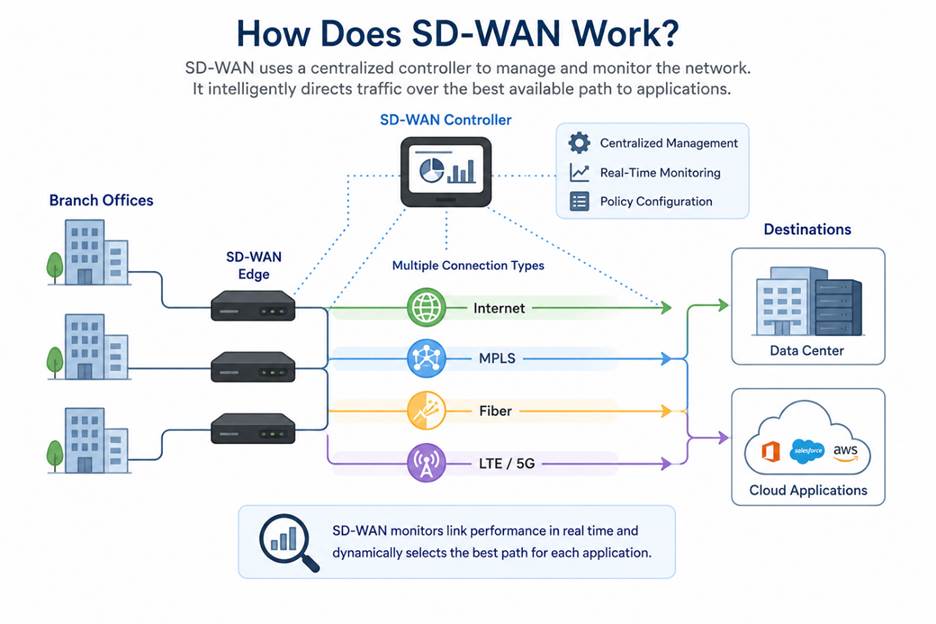
SD-WAN separates network control from the underlying physical connections, allowing organizations to manage traffic through software-defined policies instead of relying solely on fixed routing paths. Here is what the process entails:
1. Edge Device Deployment
Each branch office, data center, cloud environment, or remote site is connected through an SD-WAN edge device, which can be physical hardware, a virtual appliance, or a cloud-based instance. This creates the foundation for SD-WAN control by placing intelligent traffic-management points at the network edge.
2. Transport Link Connection
The SD-WAN device connects to one or more transport links, such as broadband internet, MPLS, fiber, LTE, or 5G. Using multiple connection types gives the network more path options and allows SD-WAN to avoid depending on a single circuit.
3. Policy Configuration
Administrators configure business and security policies through a central SD-WAN controller or management platform. These policies determine how different applications, users, sites, and traffic types are prioritized, secured, and routed.
4. Network Monitoring
The SD-WAN system continuously measures link performance, including latency, jitter, packet loss, and availability. These real-time metrics enable the platform to select the most suitable path for application traffic.
5. Application Traffic Identification
When traffic enters the SD-WAN edge, the system identifies the application or traffic type and matches it to the relevant policy. This step allows business-critical applications, such as voice, video, ERP, or cloud services, to receive appropriate handling instead of being treated like generic network traffic.
6. Dynamic Traffic Routing
Based on current network conditions and configured policies, SD-WAN automatically routes traffic over the most suitable connection. It continuously adapts routing decisions as network performance changes to maintain reliable application connectivity.
7. Network Optimization and Management
Administrators use the SD-WAN management platform to monitor network performance, adjust policies, troubleshoot issues, and onboard new sites. Centralized management reduces manual configuration and helps maintain consistent network behavior across all locations.
Key Features of SD-WAN
SD-WAN combines several technologies that improve network performance, simplify management, and support modern cloud-centric environments. The following features are among the most important capabilities that distinguish SD-WAN from traditional WAN architectures.
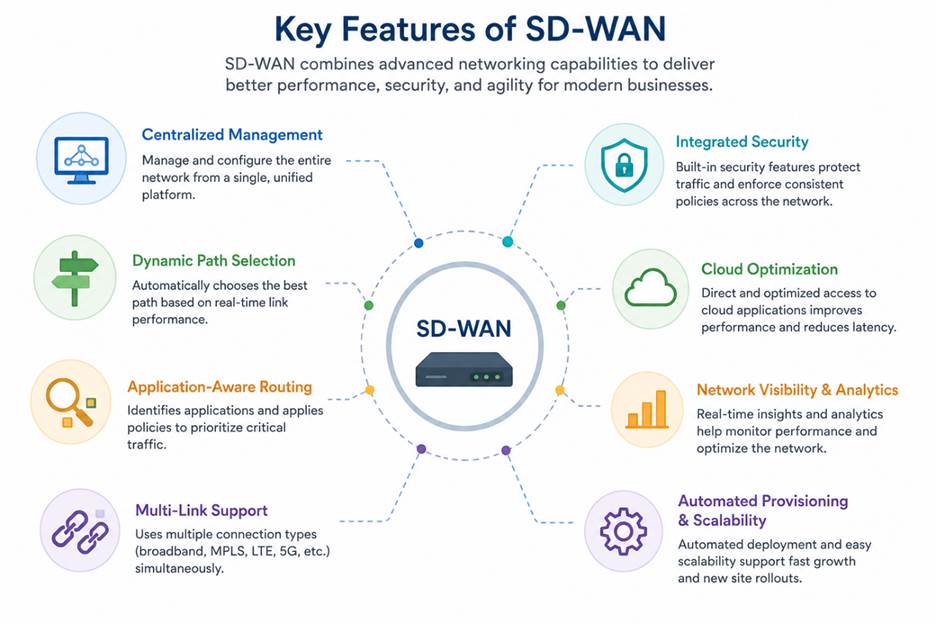
Centralized Network Management
SD-WAN allows administrators to manage the entire WAN infrastructure from a single centralized platform. Instead of configuring individual routers and appliances at each location, teams can create, deploy, and update network policies across all sites through a unified interface. This approach reduces administrative complexity, improves consistency, and simplifies network operations.
Dynamic Path Selection
SD-WAN continuously monitors the health and performance of available network connections and automatically routes traffic over the most suitable path. By evaluating metrics such as latency, packet loss, and jitter in real time, it helps ensure that applications receive reliable, high-performance connectivity.
This capability is particularly valuable for latency-sensitive applications, such as voice, video, and cloud-based collaboration tools. Key capabilities include:
- Automatic failover to a secondary connection if the primary link becomes unavailable.
- Application-aware routing based on business priorities and performance requirements.
- Continuous path optimization as network conditions change.
- Simultaneous use of multiple network paths to improve performance and resiliency.
By dynamically adapting to changing network conditions, SD-WAN helps maintain consistent application performance while improving network reliability and availability.
Application-Aware Routing
Unlike traditional networking approaches that treat most traffic similarly, SD-WAN can identify specific applications and apply customized routing policies. Business-critical applications such as VoIP, video conferencing, and cloud services can be prioritized over less important traffic, helping maintain performance and user experience even during periods of network congestion.
Policies can also define how different applications are routed, secured, and allocated bandwidth based on business requirements. This ensures that latency-sensitive applications receive the network resources they need while less critical traffic is handled without affecting essential business operations.
Multi-Link Support
SD-WAN can simultaneously use multiple connection types, including broadband internet, MPLS, fiber, LTE, and 5G. This flexibility allows organizations to combine different network transports, improve redundancy, increase available bandwidth, and reduce reliance on expensive dedicated circuits.
Rather than treating each connection independently, SD-WAN manages all available links as a unified connectivity pool. This enables organizations to:
- Use lower-cost broadband connections alongside premium MPLS circuits.
- Rely on cellular connections for backup during outages or maintenance.
- Add new transport links without major network redesigns.
- Distribute traffic across multiple connections to improve bandwidth utilization and resilience.
By supporting multiple transport technologies, SD-WAN increases network flexibility and resilience while helping organizations optimize connectivity costs.
Integrated Security
Many SD-WAN solutions include built-in security capabilities that help protect data, users, applications, and network resources across distributed environments. Common features include encryption, network segmentation, firewall functionality, secure tunneling, access controls, and identity-aware policy enforcement. These capabilities help secure traffic as it moves across public and private networks while reducing the need for separate security appliances at each location.
Centralized security management allows administrators to define and enforce consistent security policies across branch offices, data centers, cloud environments, and remote users. Many platforms also integrate with cloud-delivered security services or Secure Access Service Edge (SASE) architectures to provide advanced threat protection, secure web access, and zero-trust network access.
Cloud Optimization
SD-WAN is designed to optimize access to cloud applications and services. Instead of backhauling traffic through centralized data centers, it can route users directly to cloud platforms, reducing latency and improving performance for SaaS applications and other cloud workloads.
Key capabilities include:
- Direct internet breakout for faster access to cloud applications.
- Application-aware policies that prioritize critical SaaS traffic.
- Optimized connectivity for multi-cloud and hybrid cloud environments.
- Reduced backhaul traffic to minimize congestion and improve user experience.
By streamlining cloud connectivity, SD-WAN delivers faster, more reliable access to cloud resources regardless of user location.
Network Visibility and Analytics
SD-WAN provides detailed visibility into network performance, application usage, traffic patterns, and link health across the organization. Real-time monitoring and analytics help administrators identify bottlenecks, troubleshoot issues more quickly, optimize resource utilization, and make informed decisions about network planning and capacity management.
Centralized dashboards provide a unified view of network activity across branch offices, data centers, cloud environments, and remote locations. Administrators can monitor application performance, bandwidth consumption, link quality, and security events from a single management platform, making it easier to identify trends and respond to potential issues before they affect users.
Historical reporting and performance analytics also support capacity planning, policy optimization, and long-term network improvements by revealing usage patterns and recurring performance issues.
Automated Provisioning and Scalability
New branch offices, remote sites, and network resources can often be deployed using automated provisioning and predefined configuration templates. This capability accelerates network expansion, reduces manual setup requirements, and allows organizations to scale their infrastructure more efficiently as business needs evolve.
Centralized deployment processes also help maintain configuration consistency across the entire network:
- Zero-touch provisioning allows devices to be deployed with minimal on-site technical involvement.
- Standardized templates reduce configuration errors and simplify policy enforcement.
- Network changes can be distributed across multiple locations from a single management platform.
- New sites can be integrated into the WAN significantly faster than with traditional approaches.
By simplifying deployment and ongoing expansion, SD-WAN enables organizations to scale their networks more quickly while reducing operational complexity.
SD-WAN and SASE
SD-WAN and Secure Access Service Edge (SASE) are two complementary technologies. SD-WAN serves as the networking foundation, managing traffic, optimizing application performance, and improving visibility across distributed environments. SASE builds on that foundation by converging SD-WAN with cloud-delivered security services such as:
- Secure web gateways (SWG).
- Cloud access security brokers (CASB).
- Firewall as a service (FWaaS).
- Zero trust network access (ZTNA).
This approach allows organizations to manage connectivity and enforce security policies from a single framework, reducing complexity across distributed environments.
Organizations that have already deployed SD-WAN can adopt SASE capabilities incrementally, adding security services as their needs evolve without replacing existing network infrastructure. For those evaluating where to start, SD-WAN is typically the natural first step for improving connectivity and traffic management. SASE becomes relevant later on, as security requirements grow more complex, especially for organizations supporting large remote workforces, operating across multiple cloud environments, or moving toward a zero-trust security model.
Learn how cloud security best practices complement SD-WAN and SASE by helping protect cloud applications, data, and distributed environments.
SD-WAN Use Cases
SD-WAN is used across a wide range of industries and networking environments to improve connectivity, application performance, and operational efficiency. The technology is particularly valuable for organizations with multiple locations, cloud-based workloads, and distributed workforces.
Branch Office Connectivity
One of the most common SD-WAN use cases is connecting branch offices to corporate resources, cloud applications, and data centers.
SD-WAN simplifies branch networking by centrally managing connectivity and intelligently routing traffic across available links. This approach improves application performance, reduces dependency on costly MPLS circuits, and enables organizations to deploy new branch locations more quickly.
Cloud Application Access
Organizations increasingly rely on cloud services such as productivity suites, CRM platforms, and collaboration tools. SD-WAN improves access to these applications by providing direct internet connectivity and optimizing traffic paths based on application requirements and network conditions. As a result, users experience lower latency and more consistent performance when accessing cloud resources.
Hybrid and Multi-Cloud Networking
Many businesses operate workloads across multiple cloud providers as well as private data centers. SD-WAN helps create a unified network fabric that securely connects these environments while simplifying traffic management. This allows organizations to optimize connectivity between cloud platforms, improve workload performance, and maintain consistent network policies across diverse infrastructures.
Remote and Hybrid Work Support
As remote and hybrid work models become more common, organizations need secure and reliable connectivity for users outside traditional office locations. SD-WAN helps extend optimized network access to remote employees by intelligently routing traffic and supporting secure connections to business applications, whether they are hosted on-premises or in the cloud.
MPLS Cost Optimization
Many organizations use SD-WAN to reduce their dependence on expensive MPLS services. By leveraging broadband internet, fiber, LTE, and 5G connections, either alongside or in place of MPLS circuits, SD-WAN can reduce networking costs while maintaining performance and reliability. This approach allows businesses to allocate premium connectivity resources only where they provide the greatest value.
Business Continuity and Disaster Recovery
SD-WAN enhances network resilience by using multiple network paths and automatically rerouting traffic when connectivity issues occur. If a circuit fails or experiences degraded performance, traffic can be redirected to an alternative connection with minimal disruption. This capability helps organizations maintain operations and supports disaster recovery strategies by reducing downtime.
Retail and Distributed Enterprise Networks
Retail chains, financial institutions, healthcare providers, and other distributed enterprises often manage hundreds or thousands of locations. SD-WAN simplifies network administration across these sites by centralizing policy management, improving application performance, and enabling consistent security controls. This helps organizations support critical business applications while reducing operational complexity.
Internet of Things (IoT) Connectivity
Organizations deploying IoT devices across multiple locations can use SD-WAN to securely connect and manage traffic from sensors, cameras, industrial equipment, and other connected devices. Application-aware traffic management and network segmentation help ensure that IoT communications remain efficient and secure without impacting the performance of other business applications.
SD-WAN Benefits
SD-WAN offers several advantages over traditional WAN architectures by improving network performance, flexibility, visibility, and operational efficiency, including:
- Improved application performance. SD-WAN dynamically routes traffic over the most suitable network paths to reduce latency, packet loss, and other performance issues affecting business-critical applications.
- Lower networking costs. Organizations can reduce their dependence on expensive MPLS circuits by incorporating broadband internet, fiber, LTE, and 5G connections into their WAN strategy.
- Centralized management. A single management platform allows administrators to configure policies, monitor performance, and manage network resources across all locations from one interface.
- Enhanced network reliability. Multiple network connections and automatic failover capabilities help maintain connectivity and minimize downtime.
- Better cloud connectivity. Direct access to cloud applications reduces unnecessary traffic backhauling and improves the user experience for SaaS and cloud-based services.
- Simplified branch deployments. Automated provisioning and centralized configuration make it easier and faster to deploy new branch offices and remote locations.
- Greater scalability. Organizations can expand their networks more efficiently by adding new sites, users, and connectivity options without extensive infrastructure changes.
- Improved network visibility. Real-time monitoring and analytics provide deeper insight into application performance, traffic patterns, and network health.
- Stronger security posture. Many SD-WAN solutions include integrated security features such as encryption, segmentation, secure tunneling, and policy-based access controls.
- Support for remote and hybrid work. SD-WAN helps provide reliable and secure access to business applications for users working from various locations.
By combining intelligent traffic management, centralized control, and flexible connectivity options, SD-WAN helps organizations build more efficient, resilient, and cloud-ready networks.
SD-WAN Limitations and Challenges
SD-WAN provides significant networking benefits, but organizations should also consider the challenges associated with deployment, management, and integration, which include:
- Deployment complexity. Implementing SD-WAN across multiple locations may require careful planning, network redesign, and coordination to ensure a smooth transition from existing infrastructure.
- Integration with legacy systems. Older networking equipment, applications, and security tools may not integrate seamlessly with modern SD-WAN platforms, potentially requiring upgrades or additional configuration.
- Internet dependency. Organizations that rely heavily on broadband internet connections may experience performance fluctuations caused by factors outside their direct control, such as ISP outages or congestion.
- Security configuration requirements. Although many SD-WAN solutions include security features, organizations must still properly configure policies, access controls, and segmentation to maintain a strong security posture.
- Vendor lock-in risks. Some SD-WAN platforms use proprietary technologies and management tools that can complicate future migrations or multi-vendor deployments.
- Performance across diverse networks. Maintaining consistent performance can be challenging when network links vary in quality, bandwidth, or reliability across different locations.
- Operational learning curve. Network teams may need additional training to effectively manage SD-WAN environments, especially when adopting advanced features such as application-aware routing and automated policy management.
- Troubleshooting complexity. While SD-WAN improves visibility, diagnosing issues across multiple connection types, cloud services, and distributed environments still requires specialized expertise.
- Migration and downtime risks. Transitioning from traditional WAN architectures to SD-WAN must be carefully managed to avoid service interruptions and connectivity issues during implementation.
- Ongoing subscription costs. Many SD-WAN solutions are delivered through subscription-based licensing models that introduce recurring operational expenses in addition to connectivity costs.
Despite these challenges, careful planning, proper implementation, and ongoing management can help organizations successfully deploy SD-WAN and realize its long-term operational and performance benefits.
Choosing an SD-WAN Provider
Selecting the right SD-WAN provider is an important decision that can affect network performance, security, scalability, and long-term operational efficiency. Evaluating providers against your organization's technical requirements and business goals can help ensure a successful deployment.
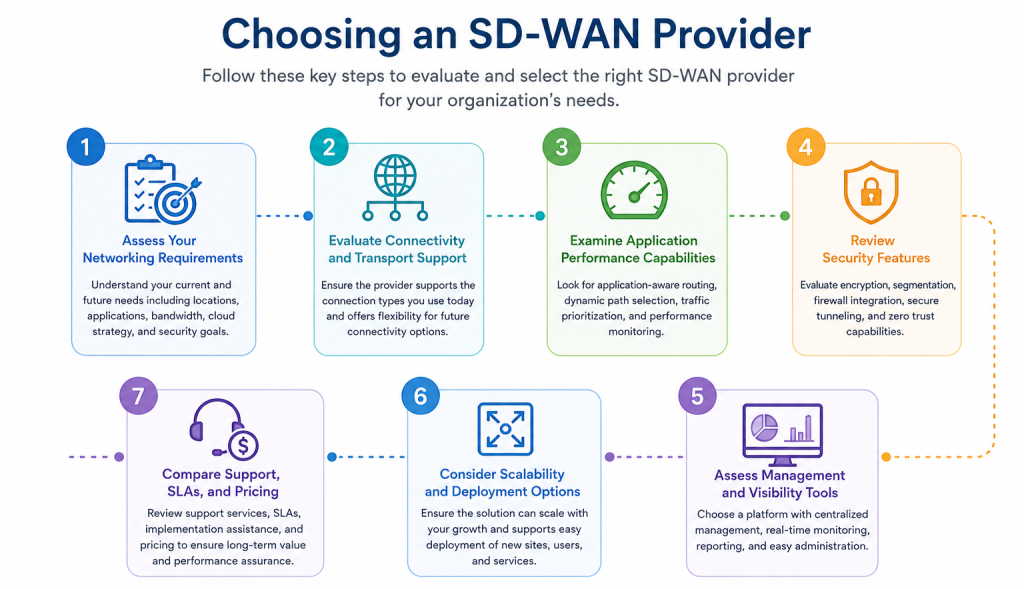
1. Assess Your Networking Requirements
Start by identifying your organization's current and future networking needs. Consider factors such as the number of locations, application requirements, cloud adoption strategy, bandwidth demands, remote workforce support, and security objectives. A clear understanding of these requirements will help narrow the list of suitable providers.
2. Evaluate Connectivity and Transport Support
Review the types of network connections supported by each provider, including broadband internet, MPLS, fiber, LTE, and 5G. The provider should support the transport options your organization currently uses while offering flexibility to adopt new connectivity technologies as requirements evolve.
3. Examine Application Performance Capabilities
Assess how the SD-WAN solution manages and optimizes application traffic. Look for features such as application-aware routing, dynamic path selection, traffic prioritization, and performance monitoring that can help maintain a consistent user experience for critical business applications.
4. Review Security Features
Security should be a key consideration when comparing SD-WAN providers. Evaluate capabilities such as encryption, network segmentation, firewall integration, secure tunneling, zero trust support, and compatibility with broader security frameworks such as SASE.
5. Assess Management and Visibility Tools
The management platform should provide centralized control, real-time monitoring, detailed reporting, and intuitive administration capabilities. Strong visibility tools can simplify troubleshooting, improve operational efficiency, and help administrators make informed network decisions.
6. Consider Scalability and Deployment Options
Choose a provider that can support future growth without requiring significant infrastructure changes. Evaluate deployment models, automated provisioning capabilities, cloud integration options, and the ease of adding new sites, users, and services as the organization expands.
7. Compare Support, SLAs, and Pricing
Review the provider's support services, service-level agreements (SLAs), implementation assistance, and pricing structure. Understanding licensing models, recurring costs, support availability, and performance guarantees can help prevent unexpected expenses and ensure the solution meets business expectations.
Choosing the right SD-WAN provider is only one part of optimizing network connectivity. Learn how carrier-neutral data centers can help organizations reduce WAN costs by providing access to multiple network carriers.
Enterprise Networking with SD-WAN: Key Takeaways
SD-WAN has become a key technology for organizations seeking to modernize their networks, improve application performance, and support increasingly distributed users and workloads. By combining centralized management, intelligent traffic routing, flexible connectivity options, and integrated security capabilities, SD-WAN helps businesses build more agile and resilient network infrastructures.
As cloud adoption, remote work, and digital transformation initiatives continue to expand, SD-WAN provides a practical foundation for delivering secure, scalable, and high-performing connectivity across modern enterprise environments.