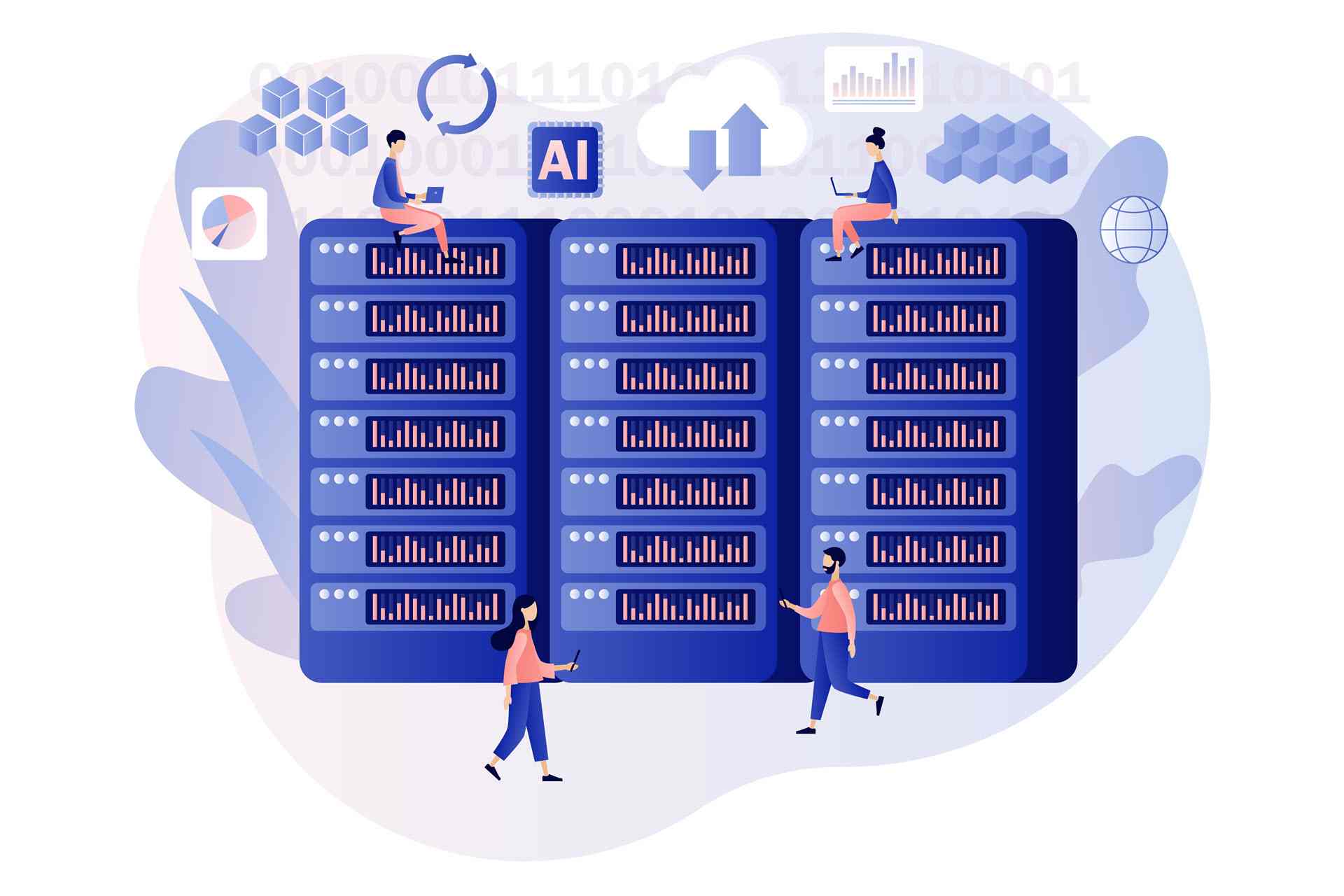
Artificial intelligence (AI) and data science are closely related fields that help organizations solve problems, automate tasks, and make better decisions using data.
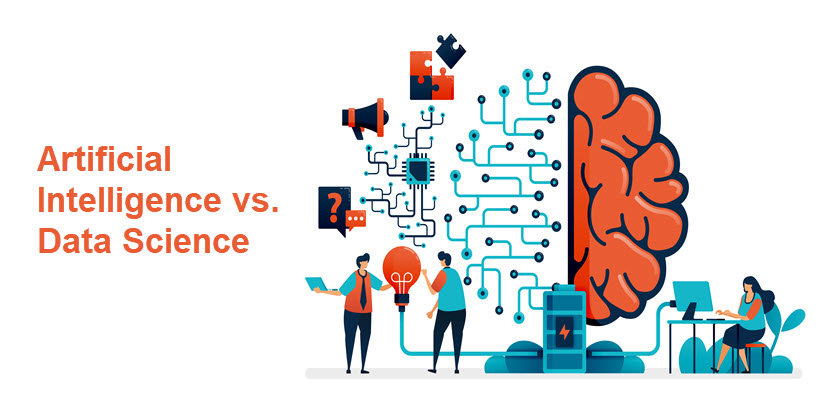
Data science focuses on collecting, processing, and analyzing data to uncover patterns and insights, while AI focuses on building systems that can perform tasks that normally require human intelligence.
This article explains the differences between artificial intelligence and data science to help you understand their tools, technologies, and expertise.
What Is Artificial Intelligence?
Artificial intelligence (AI) is a branch of computer science focused on creating systems that can perform tasks that normally require human intelligence. These tasks include understanding language, recognizing images, identifying patterns, making decisions, solving problems, and learning from data. Instead of following only fixed instructions, AI systems can analyze information, adapt to new inputs, and improve their performance over time.
Read about artificial intelligence risks to learn what to watch out for.
What Is Data Science?
Data science is an interdisciplinary field focused on collecting, processing, analyzing, and interpreting data to extract useful insights and support decision-making. It combines techniques from statistics, mathematics, computer science, and data analysis to identify patterns, trends, and relationships within large datasets. Organizations use data science to better understand operations, predict outcomes, optimize processes, and solve business problems.
Data Science vs. Artificial Intelligence: An Overview
Here is a brief overview of the differences between data science and artificial intelligence:
| Category | Artificial Intelligence (AI) | Data Science |
| Goals and Output | Builds systems that simulate human intelligence and automate decision-making. | Extracts insights and knowledge from data to support decisions. |
| Scope | Focuses on intelligent behavior, learning, reasoning, and automation. | Covers the full data lifecycle, including collection, analysis, and visualization. |
| Data Usage | Uses data mainly to train models and improve system performance. | Uses data to identify trends, patterns, and business insights. |
| Tools and Techniques | Uses machine learning, deep learning, neural networks, and AI frameworks. | Uses statistics, data analysis, visualization tools, and analytical programming libraries. |
| Workflow | Centers on training, testing, deploying, and optimizing intelligent models. | Focuses on gathering, cleaning, analyzing, and interpreting data. |
| Use Cases | Solves automation, pattern recognition, decision-making, fraud detection, content generation, and intelligent interaction challenges. | Deals with business analysis, forecasting, trend identification, operational optimization, and decision-support challenges. |
| Overlap | Shares machine learning, programming, and data processing techniques with data science. | Often incorporates AI and machine learning into analytical workflows. |
| Learning Path and Required Skills | Requires knowledge of machine learning, neural networks, mathematics, and model development. | Requires skills in statistics, data analysis, databases, visualization, and programming. |
| Organizational Roles and Team Structures | Includes AI engineers, machine learning engineers, and AI researchers. | Includes data scientists, data analysts, data engineers, and BI specialists. |
Data Science vs. Artificial Intelligence: Key Differences
Although artificial intelligence and data science are closely connected, they differ in their goals, workflows, technologies, and practical applications. Understanding these differences helps organizations choose the right approach for solving business problems, managing data, and developing intelligent systems.
The following sections compare AI and data science across several key areas, including data usage, tools, workflows, required skills, and real-world use cases.
Goals and Output
Artificial intelligence focuses on building systems that can automate tasks, make decisions, and simulate human intelligence. The output of AI is typically an intelligent behavior or action, such as recognizing speech, generating text, recommending products, or controlling autonomous systems.
Data science, on the other hand, focuses on extracting insights and knowledge from data. Its output is usually analytical results, forecasts, reports, dashboards, or predictive models that help organizations make informed decisions.
Scope
AI has a narrower but deeper focus on creating intelligent systems capable of learning, reasoning, and adapting. It includes areas such as machine learning, natural language processing, robotics, and computer vision.
Data science has a broader scope centered around the full data lifecycle, including data collection, cleaning, processing, analysis, visualization, and interpretation. While AI is often part of data science projects, data science also includes many activities unrelated to intelligent automation.
Explore how artificial intelligence in business is transforming the way companies analyze data, perform routine tasks, and boost efficiency across departments.
Data Usage
Data science relies heavily on analyzing historical and real-time data to identify trends and relationships and extract business insights. The primary goal is to understand data, measure performance using metrics and KPIs, and enable evidence-based decision-making instead of relying on assumptions.
AI also depends on data, but mainly to train algorithms that can recognize patterns and improve performance over time. In AI systems, data acts as training material that teaches models how to make predictions, classifications, or decisions automatically.
Tools and Techniques
AI commonly uses machine learning frameworks, neural networks, deep learning models, and automation algorithms. Popular AI tools include TensorFlow, PyTorch, Keras, and large language models.
Data science uses a wider range of analytical and statistical tools for processing and interpreting data, including Python, R, SQL, Tableau, Power BI, Pandas, and statistical modeling libraries.
Although both fields share technologies such as machine learning, data science places a stronger emphasis on analytics and data preparation.

Workflow
The workflow in data science usually begins with gathering and cleaning data, followed by exploration, analysis, visualization, and model development. The process ends with interpreting results and communicating findings to stakeholders.
AI workflows focus more on training, validating, and deploying intelligent models that can operate in real-world environments. AI projects often require continuous retraining and optimization to maintain accuracy and adapt to new data.
Use Cases
AI is designed to solve problems that require automation, pattern recognition, decision-making, or human-like interaction. It helps organizations automate repetitive tasks, detect fraud, recognize speech and images, generate content, improve cybersecurity monitoring, and power intelligent assistants or recommendation systems. AI is especially useful in situations where systems must process large amounts of information quickly and respond without constant human intervention.
Data science solves problems related to understanding and interpreting data. It helps businesses identify trends, forecast demand, analyze customer behavior, optimize operations, measure performance, and support strategic decision-making. Data science is commonly used when organizations need to uncover insights from large datasets, improve efficiency, reduce costs, or make predictions based on historical and real-time information.
Learn about more AI uses in our article on artificial intelligence examples and use cases.
Overlap
AI and data science overlap significantly because both fields depend on data, programming, and statistical methods. Machine learning serves as one of the largest areas of overlap, since data scientists often build predictive models while AI engineers develop systems that learn from data automatically.
The overlap between AI and data science can be observed in the way both:
- Rely heavily on collecting, processing, and analyzing data.
- Use machine learning algorithms to identify patterns and make predictions.
- Require programming skills, commonly using languages such as Python and R.
- Depend on statistics and mathematics for model development and analysis.
- Use data preprocessing techniques, such as cleaning, transformation, and normalization.
Many organizations combine AI and data science within the same projects, where data science prepares and analyzes data while AI powers intelligent automation and prediction capabilities.
Learning Path and Required Skills
Learning AI typically requires knowledge of machine learning algorithms, neural networks, mathematics, programming, and model optimization. AI professionals often specialize in deep learning, computer vision, or natural language processing.
Data science requires a broader analytical skill set that includes statistics, data analysis, data visualization, database management, and business intelligence. Both fields commonly use programming languages such as Python and require strong problem-solving abilities.
Organizational Roles and Team Structures
Organizations usually structure AI and data science teams differently based on project goals. AI teams often include machine learning engineers, AI researchers, model engineers, and software developers responsible for building and deploying intelligent systems.
Data science teams commonly include data analysts, data scientists, data engineers, and business intelligence specialists who focus on managing data pipelines, analyzing information, and generating insights. In many companies, these teams collaborate closely to support data-driven products and services.
Data Science vs. AI: Which One to Invest In?
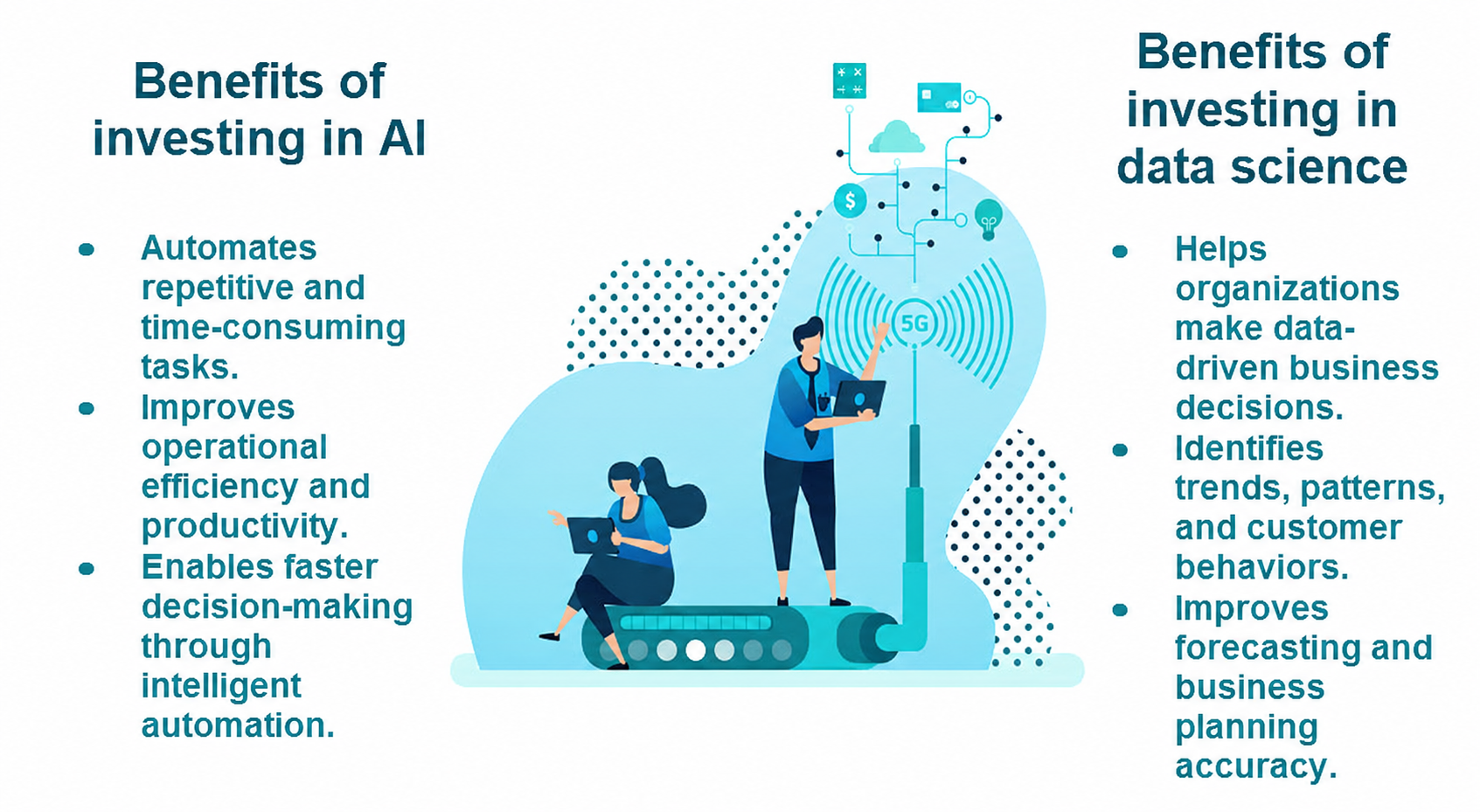
Organizations should choose between investing in artificial intelligence or data science based on their business goals, data maturity, and operational needs. Data science is often the better starting point for businesses that need to organize data, improve reporting, identify trends, and support decision-making through analytics. AI becomes more valuable when organizations want to automate processes, build intelligent applications, improve predictions, or reduce manual work at scale.
In practice, many companies invest in both fields because strong data science foundations help support successful AI initiatives. Without reliable data collection, processing, and analysis, AI systems cannot perform effectively or produce accurate results.
Learn how businesses use different AI technologies to improve operations, automation, and decision-making in our article on AI technologies.
Artificial Intelligence vs. Data Science: FAQ
Here are the answers to some of the most commonly asked questions about artificial intelligence and data science.
Are There Any Similarities Between Artificial Intelligence and Data Science?
Artificial intelligence and data science share many similarities because both fields rely heavily on data, programming, mathematics, and statistical analysis. Both disciplines use machine learning algorithms to identify patterns, make predictions, and improve decision-making processes. They also commonly use programming languages such as Python and tools for data processing, model development, and automation.
In many organizations, AI and data science work together within the same projects, where data science prepares and analyzes data while AI systems use that data to perform intelligent tasks or automate actions.
Which Is Better: Artificial Intelligence or Data Science?
Neither artificial intelligence nor data science is universally better because they solve different types of problems and often complement each other.
Data science is better suited for organizations that need to analyze data, generate insights, improve reporting, and support business decision-making. Artificial intelligence is more suitable for automating tasks, building intelligent systems, and enabling machines to make predictions or decisions with minimal human involvement.
In many cases, businesses benefit most from combining both fields, using data science to manage and understand data while leveraging AI to automate and scale processes based on that data.
Will Artificial Intelligence Replace Data Science?
Artificial intelligence is unlikely to replace data science because the two fields serve different purposes and depend on each other. AI systems require high-quality, well-structured, and properly analyzed data to function effectively, and data science provides the processes needed to collect, clean, organize, and interpret that data.
While AI can automate certain analytical tasks, data scientists are still needed to understand business problems, evaluate data quality, interpret results, and guide decision-making. Instead of replacing data science, AI is increasingly becoming a tool that enhances and automates parts of the data science workflow.
Should You Learn Data Science Before AI?
Learning data science before AI is often beneficial because it helps build the foundational skills needed to understand how AI systems work. Data science teaches important concepts such as statistics, data analysis, data processing, programming, and machine learning fundamentals, all of which are essential for developing and training AI models.
A strong understanding of data also helps improve AI model accuracy, reliability, and performance. However, the best learning path depends on individual goals. Someone focused on analytics and business intelligence may prioritize data science, while someone interested in automation, robotics, or intelligent applications may move more quickly into AI-specific topics.
AI and Data Science: Working Together to Create the Future
Artificial intelligence and data science are closely connected fields that help organizations extract value from data, improve efficiency, and solve complex problems. While data science focuses on analyzing and understanding data, AI focuses on using that data to build intelligent systems capable of automation and decision-making.
Both disciplines play important roles in modern business operations, and many organizations achieve the best results by combining them. Understanding the differences and similarities between AI and data science helps businesses choose the right technologies, develop the right skills, and build more effective data-driven strategies.