Cyber threats are becoming more frequent and sophisticated, making it increasingly difficult for organizations to detect and respond to attacks using in-house resources alone. Managed Detection and Response (MDR) addresses this challenge by combining advanced threat detection, continuous monitoring, and expert-led incident response to help organizations identify and contain security threats before they cause significant damage.
This article explains how MDR works, its key features and benefits, common use cases, and what to consider when choosing an MDR provider.

What Is Managed Detection and Response?
Managed Detection and Response is a fully managed cybersecurity service that combines advanced threat detection technologies with continuous monitoring and expert-led incident response to help organizations identify, investigate, and contain cyber threats.
Unlike traditional security tools that primarily generate alerts, MDR providers actively analyze security events, validate potential threats, and take action to mitigate attacks before they can cause significant damage. MDR services typically collect and correlate data from endpoints, networks, cloud environments, identities, and other security sources to provide comprehensive visibility across an organization's IT infrastructure.
Learn about the different types of cyberattacks that MDR protects you from.
How Does MDR Work?
Managed Detection and Response combines advanced security technologies with continuous oversight from cybersecurity experts to detect, investigate, and respond to threats throughout their lifecycle. Rather than simply generating alerts, MDR providers continuously analyze security data, validate suspicious activity, and take action to contain attacks before they can significantly impact the organization.
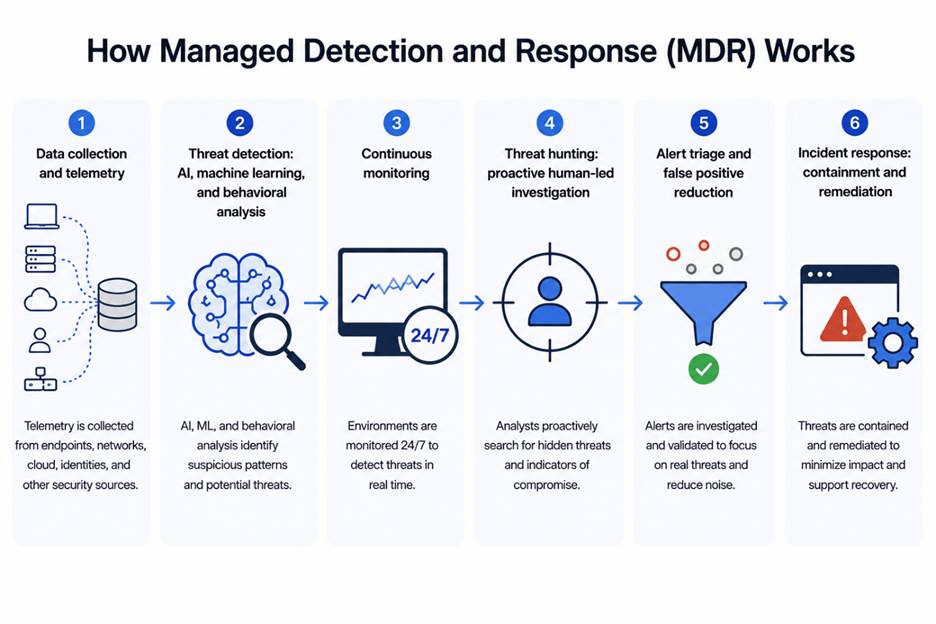
Data Collection and Telemetry
The MDR process begins by collecting telemetry from endpoints, servers, network devices, cloud workloads, user identities, applications, and other security tools. This telemetry includes information such as:
- Login attempts.
- Process execution.
- Network connections.
- File activity.
- System events.
By aggregating data from multiple sources into a centralized platform, MDR services gain the visibility needed to identify suspicious behavior that might otherwise go unnoticed.
Threat Detection: AI, Machine Learning, and Behavioral Analysis
Once telemetry is collected, MDR platforms analyze the data using a combination of artificial intelligence (AI), machine learning (ML), behavioral analytics, and threat intelligence.
AI and ML help identify unusual patterns, while behavioral analysis detects deviations from normal user or system activity that may indicate an attack. These techniques enable MDR to identify both known threats, such as malware, and more sophisticated attacks that do not match traditional signature-based detection methods.
Continuous Monitoring
MDR providers continuously monitor customer environments around the clock to detect threats as soon as they emerge. Automated monitoring systems inspect incoming telemetry in real time, while security analysts review high-priority events and investigate suspicious activity. This continuous visibility allows organizations to identify attacks that occur outside normal business hours and significantly reduces the time between initial compromise and detection.
Learn how to benefit from implementing Continuous Threat Exposure Management (CTEM) to add another layer of security to your data and operations.
Threat Hunting: Proactive Human-Led Investigation
In addition to automated detection, MDR teams perform proactive threat hunting to uncover threats that may evade traditional security controls. Experienced analysts search for indicators of compromise, attacker techniques, and suspicious behaviors that automated systems may not classify as malicious. These include:
- Unusual authentication activity.
- Lateral movement.
- Abnormal privilege escalation.
- Persistence mechanisms.
- Suspicious network traffic.
This human-led investigation helps identify advanced persistent threats (APTs), insider threats, and stealthy attacks before they escalate into larger security incidents.
Alert Triage and False Positive Reduction
Not every security alert represents a genuine threat. MDR analysts investigate and validate alerts to determine which events require action and which can be safely dismissed. By correlating data from multiple sources and applying expert analysis, MDR providers significantly reduce false positives, allowing security teams to focus on real threats instead of spending time investigating harmless events.
Incident Response: Containment and Remediation
When a confirmed threat is identified, the MDR provider initiates incident response procedures to contain and remediate the attack. Depending on the service level, this may include:
- Isolating compromised endpoints.
- Disabling affected user accounts.
- Blocking malicious network traffic.
- Terminating malicious processes.
- Coordinating directly with the customer's IT team.
After the immediate threat is contained, analysts provide guidance for remediation, recovery, and strengthening security controls to reduce the risk of similar attacks in the future.
Key Components of an MDR Service
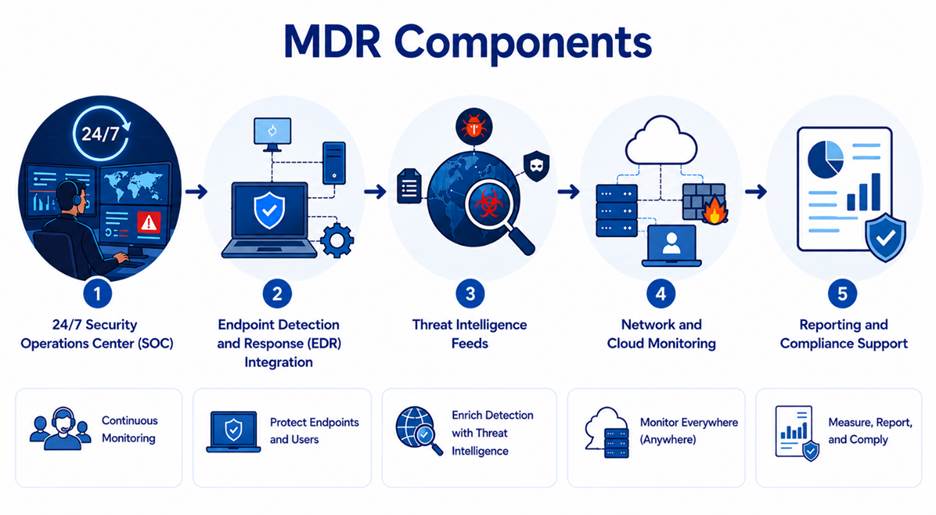
An MDR service combines several technologies and operational capabilities to provide continuous threat detection and response. Together, these components improve visibility across the environment, accelerate incident response, and help organizations strengthen their overall security posture.
24/7 Security Operations Center (SOC)
A 24/7 Security Operations Center (SOC) is the operational core of an MDR service. Staffed by cybersecurity analysts, the SOC continuously monitors security events, investigates suspicious activity, validates alerts, and coordinates incident response at any time of day. Around-the-clock coverage enables organizations to detect and respond to threats even outside normal business hours.
Endpoint Detection and Response (EDR) Integration
MDR services commonly integrate with Endpoint Detection and Response (EDR) platforms to collect detailed telemetry from desktops, laptops, servers, and other endpoints. EDR provides visibility into processes, file activity, user behavior, and system events, allowing MDR analysts to detect malicious activity, investigate incidents, and remotely isolate compromised devices when necessary.
Threat Intelligence Feeds
Threat intelligence feeds provide MDR platforms with continuously updated information about known cyber threats, including malicious IP addresses, domains, malware signatures, attacker tactics, and emerging vulnerabilities. By correlating this intelligence with security events, MDR providers can identify threats more accurately, prioritize high-risk incidents, and detect attacks that match known indicators of compromise.
Network and Cloud Monitoring
Modern MDR services monitor both on-premises networks and cloud environments to provide comprehensive visibility across an organization's infrastructure. By analyzing network traffic, cloud workloads, user identities, applications, and security logs, MDR helps detect suspicious activity regardless of where systems and data are hosted, making it well suited for hybrid and multi-cloud environments.
Reporting and Compliance Support
MDR providers generate detailed reports that summarize detected threats, security incidents, response activities, and overall security trends. These reports help organizations measure the effectiveness of their security operations, demonstrate compliance with regulatory requirements, support security audits, and identify areas where security controls can be improved.
What Challenges Does MDR Solve?
Modern organizations face increasingly complex cybersecurity threats while often lacking the people, resources, and time needed to manage security effectively. Managed Detection and Response addresses the following challenges:
- Limited in-house expertise and the cybersecurity talent gap. Many organizations struggle to recruit and retain experienced cybersecurity professionals. MDR provides access to dedicated security analysts and incident responders without requiring businesses to build and staff their own SOC.
- Resource constraints and alert fatigue. Security teams often receive thousands of alerts every day, many of which are false positives. MDR filters, validates, and prioritizes alerts so internal teams can focus on genuine security incidents instead of investigating routine or low-risk events.
- Rapid threat evolution and sophisticated attacks. Cybercriminals continuously develop new malware, ransomware, phishing campaigns, and attack techniques that can bypass traditional security tools. MDR combines threat intelligence, behavioral analytics, AI, and human expertise to detect both known and emerging threats.
- Lack of 24/7 security monitoring. Many organizations cannot provide around-the-clock security coverage with internal staff alone. MDR delivers continuous monitoring and incident response, helping detect and contain attacks regardless of when they occur.
- Compliance and regulatory requirements. Many industries must meet strict security and reporting requirements under standards such as HIPAA, PCI DSS, GDPR, or ISO 27001. MDR supports compliance by maintaining security monitoring, documenting incidents, and generating reports that assist with audits and regulatory obligations.
By addressing these operational and technical challenges, MDR enables organizations to strengthen their security posture, respond to threats more effectively, and reduce the burden on internal IT and security teams.
Who Needs Managed Detection and Response?
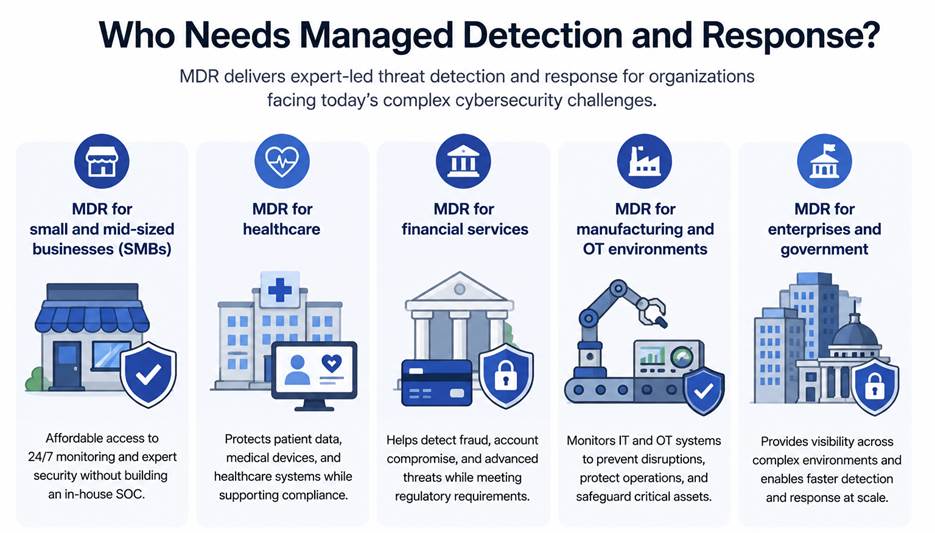
Managed Detection and Response is valuable for organizations of all sizes that need stronger cybersecurity without the cost and complexity of building a fully staffed in-house security operations center. While the specific security challenges vary by industry, MDR provides continuous monitoring, expert threat detection, and rapid incident response to help protect critical systems and data.
MDR for Small and Mid-Sized Businesses (SMBs)
Small and mid-sized businesses often lack the budget and personnel needed to maintain a 24/7 security operations team. MDR gives SMBs access to enterprise-grade threat detection, continuous monitoring, and experienced security analysts, enabling them to improve their security posture without investing in a large internal cybersecurity team.
MDR for Healthcare
Healthcare organizations manage sensitive patient information and operate systems that must remain available at all times. MDR helps protect electronic health records (EHRs), connected medical devices, and healthcare networks from ransomware, phishing, and data breaches while supporting compliance with healthcare security and privacy regulations.
MDR for Financial Services
Banks, insurance companies, investment firms, and other financial institutions are frequent targets of cyberattacks due to the sensitive financial data they manage. MDR helps detect fraud, account compromise, ransomware, and other advanced threats while supporting regulatory compliance and minimizing operational disruptions.
MDR for Manufacturing and OT Environments
Manufacturing organizations rely on operational technology (OT), industrial control systems (ICS), and connected production equipment to maintain business operations. MDR helps monitor both IT and OT environments for cyber threats that could disrupt production, compromise intellectual property, or impact critical infrastructure, while providing visibility across increasingly connected industrial networks.
MDR for Enterprises and Government
Large enterprises and government organizations typically operate complex, distributed IT environments with thousands of users, endpoints, cloud workloads, and business applications. MDR provides centralized visibility, continuous threat monitoring, and rapid incident response across these environments, helping security teams detect sophisticated attacks, reduce response times, and strengthen their overall cybersecurity resilience.
MDR vs. Other Security Solutions
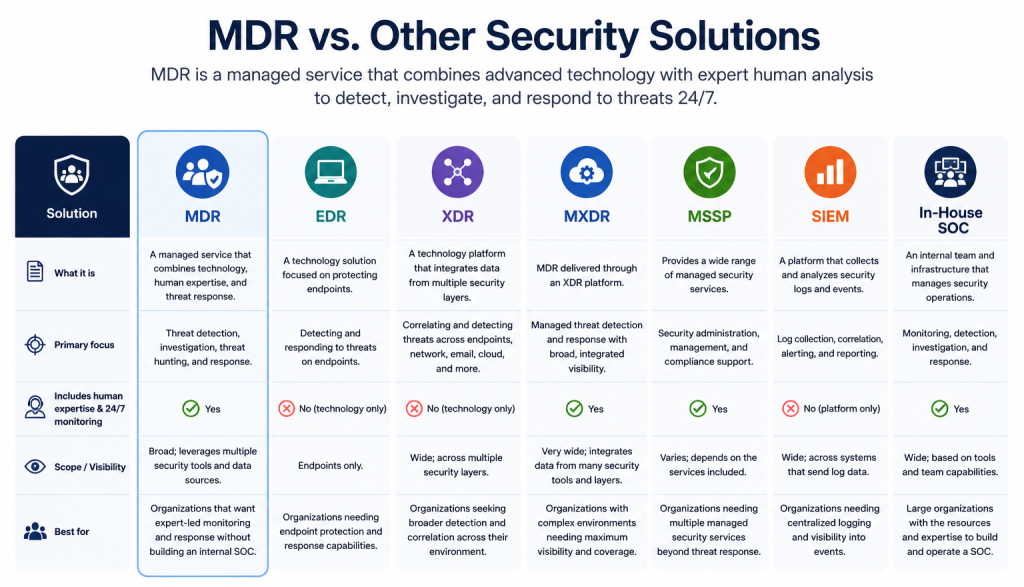
Managed Detection and Response is part of a broader cybersecurity ecosystem that includes security tools, managed services, and in-house security operations. Although these solutions often work together, they differ in terms of capabilities, level of management, and the role they play in detecting and responding to cyber threats.
MDR vs. XDR
Endpoint Detection and Response is a security technology that monitors and protects endpoints such as laptops, desktops, and servers. MDR builds on EDR by adding 24/7 monitoring, expert threat analysis, threat hunting, and incident response. While EDR provides the tools, MDR provides the people and processes needed to actively manage them.
MDR vs. XDR
Extended Detection and Response (XDR) is a technology platform that correlates security data from multiple sources, including endpoints, networks, email, identities, and cloud environments. MDR is a managed service that may use XDR as one of its underlying technologies, while also providing human expertise, continuous monitoring, and response capabilities that XDR alone does not offer.
MDR vs. MXDR
Managed Extended Detection and Response (MXDR) combines MDR services with an XDR platform to deliver broader visibility across multiple security layers. Compared to traditional MDR, MXDR places greater emphasis on integrating and analyzing data from a wider range of security tools, making it well suited for organizations with complex or highly distributed IT environments.
MDR vs. MSSP
Managed Security Service Providers (MSSPs) deliver a broad range of outsourced security services, such as firewall management, vulnerability management, endpoint protection, and compliance support. MDR is more specialized, focusing specifically on advanced threat detection, investigation, threat hunting, and rapid incident response rather than general security administration.
MDR vs. SIEM
Security Information and Event Management (SIEM) platforms collect, store, and analyze security logs from across an organization's infrastructure. SIEM provides centralized visibility and alerting, but it typically requires internal teams to investigate and respond to incidents. MDR complements or manages SIEM by adding expert analysis, continuous monitoring, threat hunting, and active incident response.
MDR vs. In-House SOC
An in-house Security Operations Center gives organizations complete control over their security operations, but requires significant investment in skilled personnel, security tools, and ongoing operations. MDR offers many of the same capabilities through a fully managed service, allowing organizations to benefit from experienced security analysts and continuous monitoring without the cost and complexity of building and maintaining their own SOC.
Learn how to implement social media security as a part of your security efforts.
Common Threats MDR Protects Against
MDR is useful in preventing the following threats:
- Ransomware attacks. MDR detects the early signs of ransomware, such as unusual file encryption or lateral movement, enabling rapid containment before the attack spreads.
- Advanced persistent threats (APTs). MDR identifies long-term, stealthy attacks through continuous monitoring, behavioral analysis, and proactive threat hunting.
- Insider threats. MDR monitors user activity to detect suspicious behavior from employees, contractors, or compromised accounts that could lead to data theft or system misuse.
- Phishing and identity-based attacks. MDR helps detect credential theft, account compromise, privilege escalation, and other attacks that target user identities through phishing or social engineering.
- Supply chain attacks. MDR monitors for malicious activity originating from trusted software, third-party vendors, or compromised service providers that could impact the organization's environment.
- Malware and zero-day attacks. MDR uses behavioral analytics, threat intelligence, and machine learning to detect malicious software and previously unknown threats that may not have established signatures.
- Lateral movement and privilege escalation. MDR identifies attackers attempting to move across networks or gain elevated privileges after gaining initial access, helping stop attacks before critical systems are compromised.
- Command-and-control (C2) activity. MDR detects suspicious outbound communications between compromised devices and attacker-controlled infrastructure, allowing organizations to isolate infected systems quickly.
By detecting and responding to these threats early, MDR helps organizations reduce cyber risk, minimize business disruption, and strengthen their overall security resilience.
Benefits of Managed Detection and Response
Managed Detection and Response offers the following benefits to organizations:
- Cost-effectiveness. MDR eliminates the need to hire and retain a large team of security specialists or invest in expensive security infrastructure, making enterprise-grade security more affordable.
- Faster threat detection and response times. Continuous monitoring, automated detection, and expert-led incident response help identify and contain threats before they spread or cause significant damage.
- Faster deployment and time to value. Organizations can quickly implement MDR services without the lengthy process of building a Security Operations Center, allowing them to improve their security posture sooner.
- Enhanced visibility and reporting. MDR provides centralized visibility across endpoints, networks, cloud environments, and user identities, along with detailed reporting that helps organizations understand their security posture and incident trends.
- Access to specialized cybersecurity expertise. MDR gives organizations access to experienced security analysts, threat hunters, and incident responders who continuously investigate threats and provide expert guidance during security incidents.
- Compliance and audit readiness. MDR supports compliance with regulatory and industry frameworks such as HIPAA, SOC 2, NIST, and CMMC by maintaining continuous monitoring, documenting security events, and generating reports that support audits and security assessments.
- Reduced alert fatigue. By validating and prioritizing security alerts, MDR minimizes false positives and allows internal IT teams to focus on high-priority threats instead of routine investigations.
- Scalability for growing organizations. MDR services can expand alongside the organization's infrastructure, providing consistent protection as users, devices, applications, and cloud resources grow.
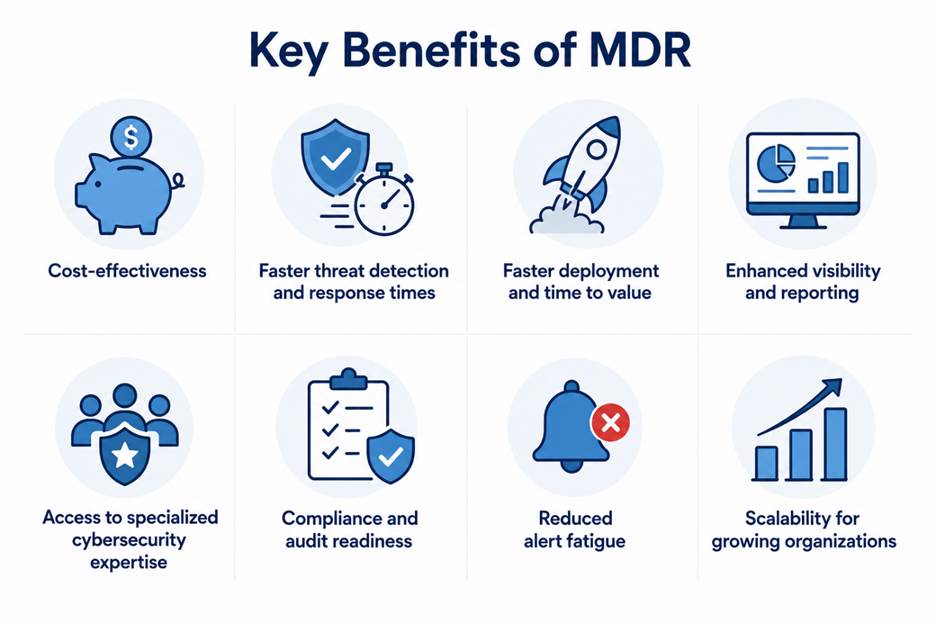
By combining technology, expertise, and continuous operations, MDR enables organizations to improve security, reduce operational burden, and respond to cyber threats more quickly and effectively.
Types of MDR Providers
Organizations can choose from several types of MDR services depending on their existing security tools, internal expertise, and operational requirements. While all MDR providers focus on threat detection and response, they differ in how they deliver their services and integrate with customer environments.
| MDR Provider | Description | Best Fit For |
| Pure-Play MDR Providers | Independent providers that specialize exclusively in managed detection, threat hunting, and incident response. They typically support a wide range of third-party security tools and technologies. | Organizations seeking a vendor-neutral MDR service with broad technology compatibility. |
| Vendor-Led MDR | MDR services delivered by cybersecurity vendors using their own security products, such as endpoint protection, XDR, or cloud security platforms. These services are tightly integrated with the vendor's technology ecosystem. | Organizations already invested in a specific security vendor's products. |
| MSSP-Evolved MDR | MSSPs that have expanded their offerings to include advanced threat detection, threat hunting, and incident response alongside traditional managed security services. | Organizations looking for a single provider to manage multiple security functions. |
| Co-Managed MDR | A collaborative approach in which the MDR provider works alongside the organization's internal security or IT team. Responsibilities for monitoring, investigation, and incident response are shared based on agreed roles. | Organizations with an existing security team that want additional expertise and 24/7 operational support. |
How to Choose an MDR Provider?
To choose the right Managed Detection and Response, follow these steps:
- Evaluate detection and response capabilities. Ensure the provider offers 24/7 monitoring, proactive threat hunting, rapid incident response, and expert security analysts.
- Review technology compatibility. Confirm that the MDR service integrates with your existing security tools, cloud platforms, endpoints, and network infrastructure.
- Assess response capabilities. Determine whether the provider only notifies your team of threats or actively contains and remediates incidents on your behalf.
- Verify industry expertise. Choose a provider with experience protecting organizations in your industry and supporting your specific security and compliance requirements.
- Consider reporting and compliance support. Look for detailed reporting, audit-ready documentation, and support for regulatory frameworks such as HIPAA, SOC 2, NIST, or CMMC.
- Understand service level agreements (SLAs). Review response times, escalation procedures, availability, and customer support commitments before selecting a provider.
- Evaluate scalability. Select an MDR service that can grow with your organization and support future expansion across users, devices, cloud environments, and locations.
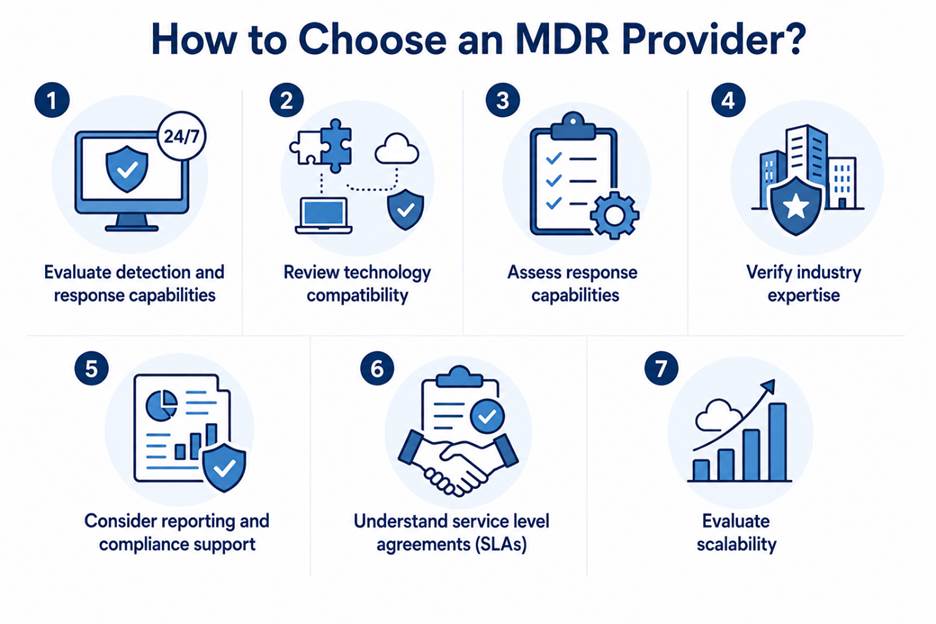
By selecting an MDR provider that matches your technical requirements and business objectives, you can improve your organization's ability to detect, respond to, and recover from evolving cyber threats.
MDR Pricing
Managed Detection and Response pricing depends on factors such as the size of the organization, the number of protected endpoints and users, the level of monitoring and response provided, and the complexity of the IT environment.
Most providers use subscription-based pricing with monthly or annual billing, while some offer tiered plans based on features or service levels. Organizations should evaluate pricing alongside factors such as response capabilities, technology integration, reporting, and service level agreements to ensure they receive the best overall value rather than selecting a provider based on cost alone.
MDR Implementation
Implementing Managed Detection and Response is a structured process that integrates the provider's security platform with an organization's existing IT environment. While the exact implementation varies by provider, most deployments follow a similar series of steps that establish visibility, configure monitoring, and prepare the organization for continuous threat detection and incident response.
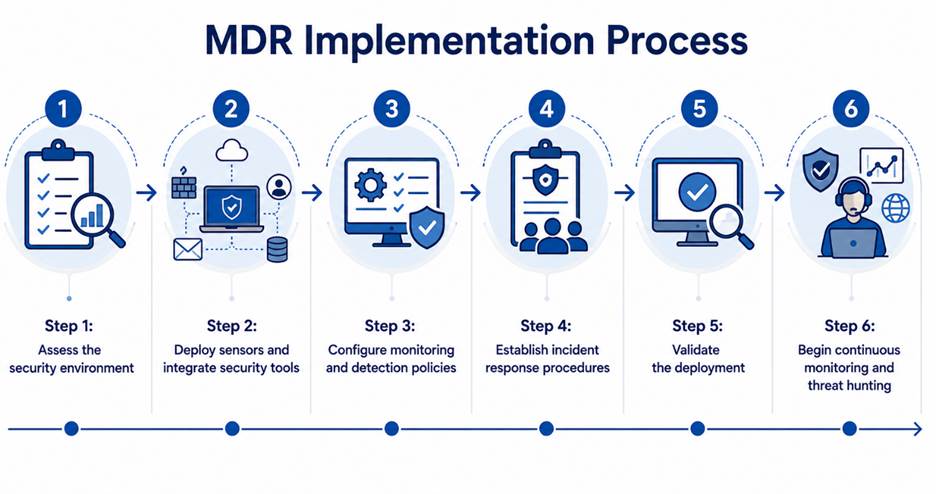
Step 1: Assess the security environment
The implementation begins with an assessment of the organization's existing security infrastructure, assets, and business requirements. The MDR provider identifies critical systems, evaluates current security controls, reviews compliance requirements, and determines which endpoints, networks, cloud resources, and applications should be monitored.
Step 2: Deploy sensors and integrate security tools
Next, the provider deploys endpoint agents or sensors where needed and integrates the MDR platform with existing security technologies such as EDR, SIEM, firewalls, identity providers, cloud platforms, and email security solutions. These integrations allow the MDR service to collect telemetry from across the environment.
Step 3: Configure monitoring and detection policies
After data sources are connected, the MDR provider configures monitoring rules, detection policies, alert thresholds, and response workflows. These settings are tailored to the organization's infrastructure, security objectives, and risk profile to improve detection accuracy while minimizing unnecessary alerts.
Step 4: Establish incident response procedures
The organization and MDR provider define how security incidents will be handled, including communication channels, escalation paths, response responsibilities, and authorization for containment actions. Establishing these procedures ensures security incidents can be managed quickly and consistently when they occur.
Step 5: Validate the deployment
Before the service becomes fully operational, the provider verifies that telemetry is being collected correctly, integrations are functioning as expected, and detection rules are generating accurate results. Test alerts and validation exercises help confirm that the MDR environment is ready for production.
Step 6: Begin continuous monitoring and threat hunting
Once deployment is complete, the MDR service transitions into continuous operation. Security analysts monitor the environment around the clock, investigate suspicious activity, proactively hunt for hidden threats, and respond to confirmed incidents while providing regular reporting and recommendations to improve the organization's security posture.
Limitations and Challenges of MDR
While Managed Detection and Response provides significant security benefits, it is not a complete cybersecurity solution. Its limitations include:
- Dependence on a third-party provider. Organizations rely on the MDR provider's expertise, availability, and response capabilities. Choosing a trusted provider with strong service level agreements and transparent communication is essential.
- Data privacy and sovereignty concerns. MDR services often require access to security logs and telemetry that may contain sensitive information. Organizations should verify how customer data is collected, stored, processed, and protected, especially when operating under data residency or privacy regulations.
- Cost considerations and total cost of ownership. Although MDR is often more cost-effective than building an internal SOC, pricing varies based on service scope, infrastructure size, response capabilities, and licensing requirements. Additional costs may apply for premium response services or third-party security tools.
- MDR scope and limitations. MDR focuses on threat detection, investigation, and incident response, but it does not replace other essential security functions such as vulnerability management, patch management, security awareness training, backup and disaster recovery, or broader IT administration.
- Dependence on telemetry quality. MDR can only detect threats within the visibility it has. Missing endpoint agents, incomplete log collection, or limited integrations can reduce detection accuracy and leave security gaps.
- Shared responsibility for security. Even with an MDR service, organizations remain responsible for maintaining secure configurations, applying software updates, enforcing security policies, and addressing identified vulnerabilities.
- Integration complexity. Deploying MDR across large or highly customized environments may require integrating multiple security tools, cloud platforms, and legacy systems, which can increase implementation effort and ongoing management.
Understanding these limitations helps organizations deploy MDR as part of a layered cybersecurity strategy, where managed detection and response complements other security technologies and best practices.
Future of MDR
Managed Detection and Response continues to evolve as cyber threats become more sophisticated and organizations adopt increasingly complex IT environments. Advances in artificial intelligence, broader security platform integration, and new regulatory requirements are shaping the next generation of MDR services, making them more intelligent, automated, and comprehensive.
1. AI and Agentic Automation in MDR
Artificial intelligence is playing an increasingly important role in MDR by improving threat detection, prioritizing alerts, and accelerating incident investigations. Emerging agentic AI capabilities are expected to automate more complex security tasks, such as correlating attack activity, recommending response actions, and executing approved remediation workflows under human oversight. While security analysts will remain essential for handling complex incidents and strategic decision-making, AI will help reduce manual effort and shorten response times.
Read more about artificial intelligence technologies that enable additional security layers for your sensitive data.
2. MXDR and Extended Coverage Trends
Many MDR providers are expanding toward Managed Extended Detection and Response, which integrates telemetry from endpoints, networks, cloud platforms, email systems, identities, and other security technologies into a unified service. This broader visibility enables providers to detect sophisticated attacks that span multiple environments while improving investigation accuracy and reducing blind spots across hybrid and multi-cloud infrastructures.
3. Regulatory Drivers (NIS2, CMMC, and Beyond)
Growing cybersecurity regulations are increasing the demand for continuous monitoring, incident reporting, and stronger security controls. Frameworks and regulations such as NIS2, CMMC, and evolving industry-specific requirements encourage organizations to strengthen their detection and response capabilities. As regulatory expectations continue to expand, MDR services are expected to play a larger role in helping organizations maintain compliance and demonstrate ongoing security readiness.
4. MDR Market Growth and Adoption Outlook
The MDR market is expected to continue growing as organizations face persistent cybersecurity talent shortages, expanding attack surfaces, and increasingly sophisticated threats. Small and mid-sized businesses, large enterprises, and public sector organizations are all adopting MDR to gain access to expert security operations without building their own Security Operations Centers. As security technologies become more integrated and automated, MDR is likely to become a standard component of modern cybersecurity strategies rather than an optional managed service.
Managed Detection and Response FAQs
Here are the answers to the most commonly asked questions about MDR.
Is MDR Better than EDR?
Whether Managed Detection and Response is better than Endpoint Detection and Response depends on an organization's security needs and available resources.
EDR is a security technology that monitors and protects endpoints by detecting suspicious activity and providing investigation and response tools, but it typically requires an internal security team to manage alerts and respond to incidents. MDR builds on technologies such as EDR by adding 24/7 monitoring, threat hunting, expert analysis, and managed incident response.
Organizations with experienced security teams may benefit from managing EDR themselves, while those with limited cybersecurity resources often find MDR to be the more effective option because it combines advanced technology with dedicated security expertise.
Is an MDR a SIEM?
No, Managed Detection and Response is not the same as a Security Information and Event Management (SIEM) platform, although the two are often used together.
A SIEM collects, stores, and analyzes security logs from across an organization's IT environment to provide centralized visibility and generate alerts. MDR is a managed security service that uses technologies such as SIEM, EDR, and XDR, along with continuous monitoring, threat hunting, and expert security analysts, to investigate and respond to threats.
In many cases, an MDR provider manages and enhances an organization's SIEM by validating alerts, reducing false positives, and coordinating incident response.
Is MDR Worth the Cost?
For many organizations, Managed Detection and Response is worth the cost because it provides continuous threat detection, expert incident response, and enterprise-grade security capabilities without the expense of building and operating an in-house Security Operations Center. MDR can reduce the impact of cyberattacks by improving detection accuracy and shortening response times, while also helping organizations meet compliance requirements and address cybersecurity talent shortages.
Although pricing varies based on the provider, service level, and size of the environment, many businesses find that the cost of MDR is significantly lower than the potential financial and operational impact of a successful cyberattack or the ongoing investment required to maintain a fully staffed internal security team.
Why MDR Matters
Managed Detection and Response has become an essential cybersecurity service for organizations facing increasingly sophisticated cyber threats and limited internal security resources. By combining advanced detection technologies, continuous monitoring, threat hunting, and expert-led incident response, MDR enables organizations to identify and contain attacks more quickly while improving overall security resilience.
Whether protecting a small business or a large enterprise, MDR offers a practical way to strengthen security operations, reduce cyber risk, and support compliance without the cost and complexity of building a fully staffed in-house SOC.