Choosing a cloud service provider is challenging due to the differences in pricing, performance, security, compliance, and service offering. The right cloud provider helps organizations balance cost, performance, security, and scalability while ensuring their infrastructure supports both current and future business needs.
This article explains the key factors to consider when choosing a cloud service provider and how to evaluate providers based on your technical and business requirements.
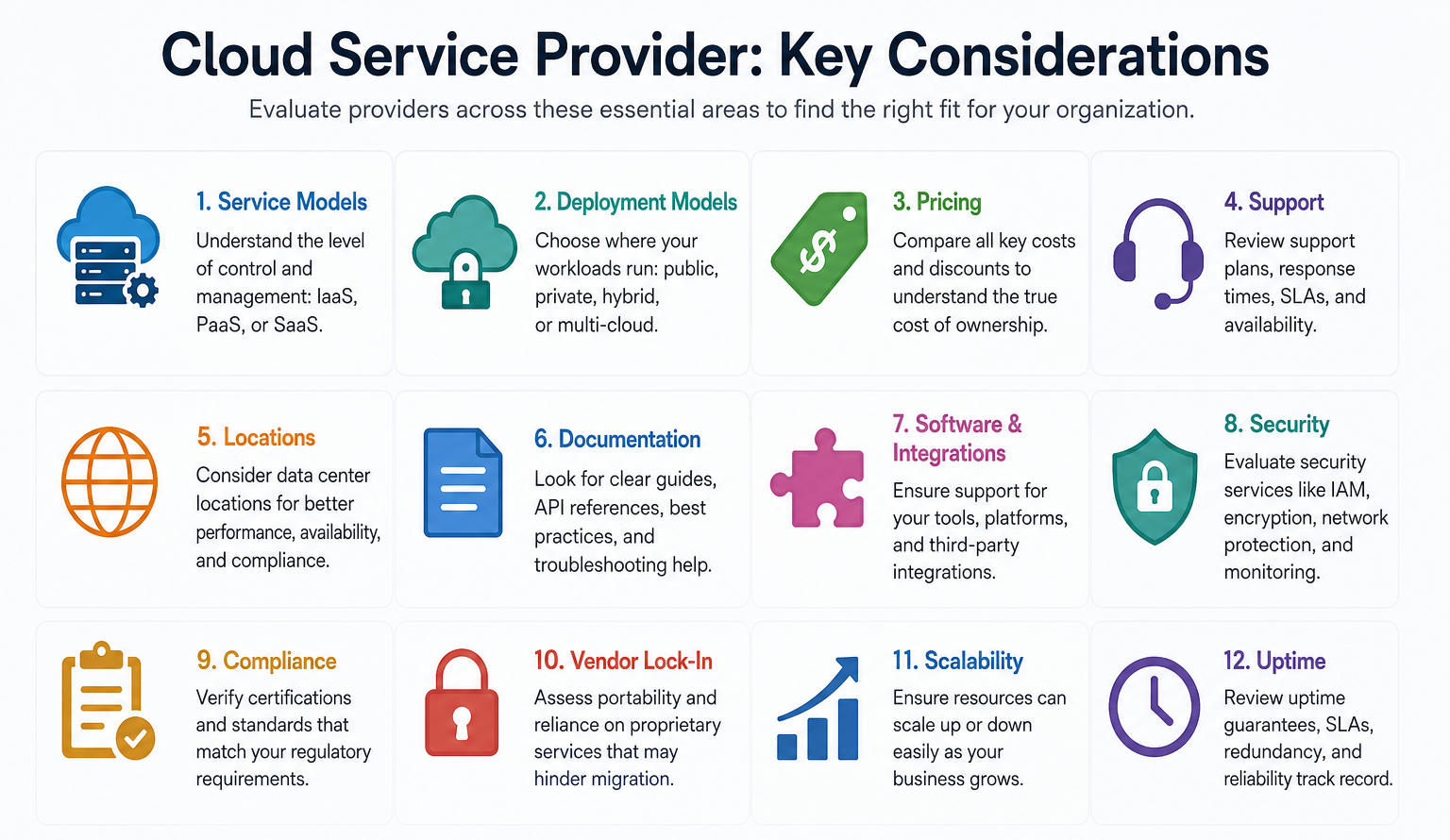
Evaluating Cloud Service Providers: Key Considerations
Choosing the right cloud service provider involves more than comparing prices. Organizations should evaluate how well a provider's services, infrastructure, security, and support align with their technical requirements, operational goals, and long-term growth plans.
1. Service Models
Cloud providers offer different service models that determine how much of the infrastructure they manage.
Common service models include:
- Infrastructure as a Service (IaaS) - provides virtual machines, storage, and networking, giving customers full control over the operating system and applications.
- Platform as a Service (PaaS) - manages the underlying infrastructure and runtime environment, allowing developers to focus on building applications.
- Software as a Service (SaaS) - delivers fully managed applications users can access using a web browser or client application.
Selecting the right model comes down to balancing control against convenience. Organizations with the technical resources to manage infrastructure may benefit from IaaS, those looking to accelerate application development without managing servers are better served by PaaS, and those requiring a ready-to-use solution with no infrastructure management should consider SaaS.
2. Deployment Models
The deployment model determines where applications and data are hosted.
Common cloud deployment models include:
- Public cloud - uses shared infrastructure managed by the provider
- Private cloud - provides dedicated infrastructure for a single organization.
- Hybrid cloud - combines on-premises infrastructure with public cloud resources
- Multi-cloud - uses services from multiple cloud providers.
Selecting a deployment model requires weighing cost efficiency against data control and regulatory needs. Organizations prioritizing affordability and scalability may lean toward public cloud, those with sensitive data or compliance obligations often require private cloud, and businesses seeking a balance of both, or looking to avoid dependence on a single provider, typically adopt hybrid or multi-cloud strategies.
3. Pricing
Cloud pricing varies between providers and services Pricing factors include:
- Compute power.
- Storage.
- Networking.
- Data transfer.
- Backups.
- Managed services.
- Support.
- Licensing.
Cloud providers may also include promotional offers for new clients and discounts for reserved or long-term usage. Looking beyond compute pricing helps organizations estimate the total cost of ownership.
Read more about different cloud computing pricing models to make an informed decision for your cloud solution.
4. Support
Reliable technical support can significantly reduce downtime and simplify issue resolution. Consider the available support plans, response times, service level agreements (SLAs), support channels, and whether assistance is available 24/7.
5. Locations
The number and location of data centers affect application performance, availability, and compliance. Providers with regions close to your users can reduce latency, while a broad geographic footprint improves availability, disaster recovery, and regulatory compliance options.
6. Documentation
Comprehensive documentation simplifies deployment and day-to-day operations.
A reliable cloud provider will offer the following supporting resources and documentation:
- SDKs.
- API references.
- Tutorials.
- Architecture guides.
- Troubleshooting resources.
- Tips and best practices.
These resources simplify client onboarding, support efficient teamwork, and minimize support requests.
7. Supported Software and Integrations
When choosing a cloud provider,ensure that their infrastructure and service offering support and integrate with your existing (or future) software stack. Software to consider includes, but is not limited to:
- Operating systems.
- Database management systems.
- Virtualization platforms.
- DevOps platforms.
- Development tools.
- Third-party services.
Strong integration capabilities simplify deployment and ongoing management.
8. Security
Evaluate both the provider's underlying infrastructure security and the security services available to customers. Key security considerations when choosing a cloud provider include:
- Identity and access management (IAM).
- Encryption.
- Network security.
- DDoS protection.
- Firewalls.
- Key management.
- Security monitoring.
- Backup and disaster recovery capabilities.
Strong security capabilities are essential for protecting cloud workloads, maintaining business continuity, and reducing security risks.
9. Compliance
Organizations operating under regulatory requirements should verify that the provider supports industry-relevant compliance standards and certifications, such as ISO 27001, SOC 2, PCI DSS, HIPAA, or GDPR. Compliance features can simplify audits and reduce operational risk.
10. Vendor Lock-In
Some cloud services make it difficult to migrate workloads to another provider. Evaluate whether applications use proprietary services, APIs, or management tools that could increase migration complexity. Providers that support open standards, containers, and infrastructure as code generally make future migrations easier.
11. Scalability
Cloud infrastructure should be able to grow with your business. Evaluate how easily resources can be scaled up or down, whether auto scaling is available, and whether the provider can accommodate future workload growth without requiring significant redesign.
12. Uptime
Application availability depends on the provider's infrastructure reliability. Review uptime guarantees, SLA commitments, redundancy across availability zones and regions, maintenance practices, and historical reliability to understand how well the provider can support business-critical workloads.
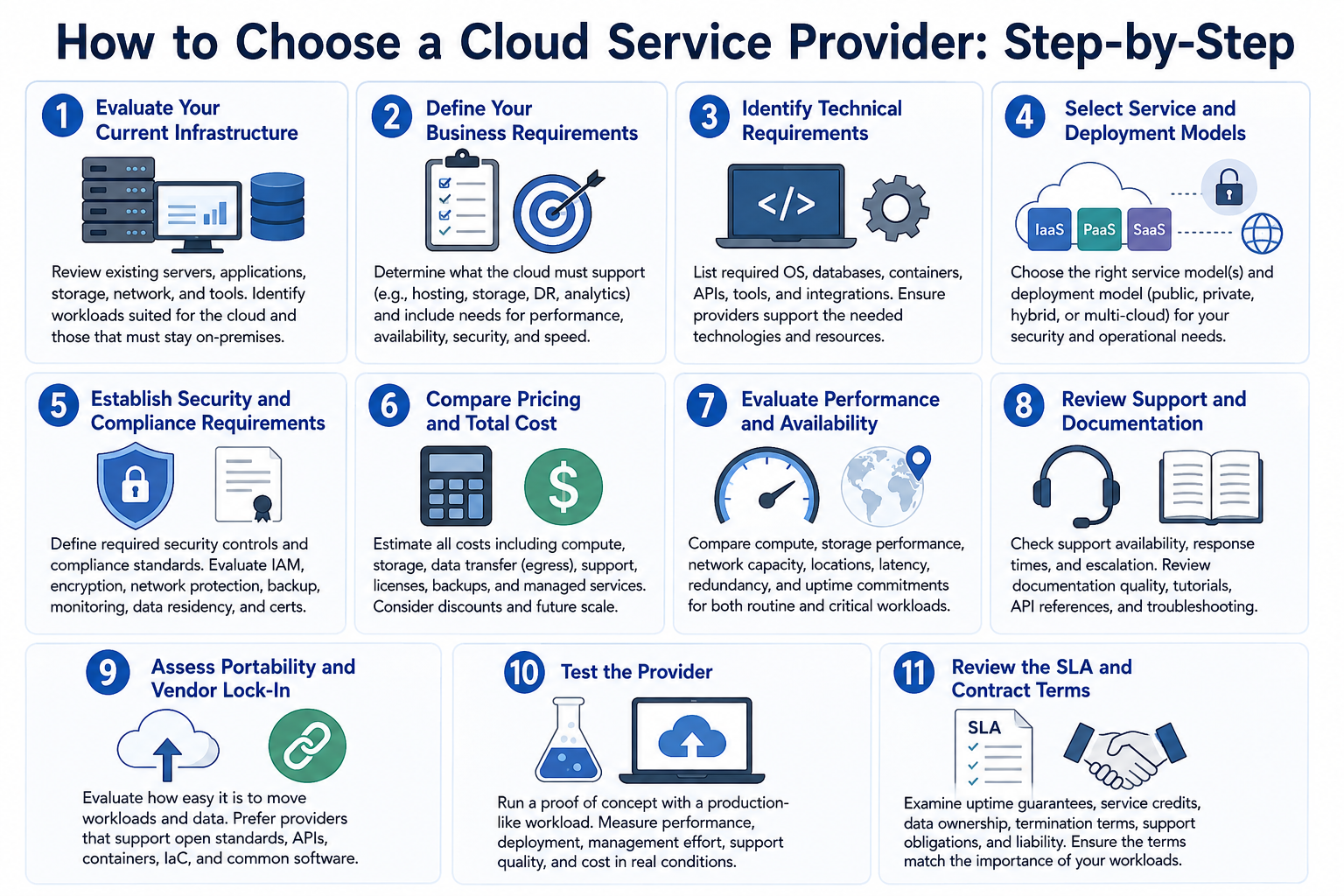
How to Choose a Cloud Service Provider
Choosing a cloud service provider requires a structured evaluation of your current environment, technical requirements, budget, and long-term goals. The following steps help narrow the options and identify the provider that best fits your organization.
Step 1: Evaluate Your Current Infrastructure
Review your existing servers, applications, storage, network architecture, and management tools. Identify which workloads can move to the cloud, which must remain on-premises, and whether any legacy systems require specialized support.
Step 2: Define Your Business Requirements
Determine what the cloud environment must support, such as application hosting, data storage, disaster recovery, development, analytics, or global expansion. Include requirements related to performance, availability, security, and deployment speed.
Step 3: Identify Technical Requirements
Document the operating systems, databases, container platforms, APIs, automation tools, and integrations your workloads depend on. Confirm that each provider supports the required technologies and offers suitable compute, storage, and networking options.
Step 4: Select the Appropriate Service and Deployment Models
Decide whether you need IaaS, PaaS, SaaS, or a combination of service models. Then determine whether a public, private, hybrid, or multi-cloud deployment best fits your security, control, and operational requirements.
Step 5: Establish Security and Compliance Requirements
Define the security controls and regulatory standards the provider must support. Evaluate identity and access management, encryption, network protection, monitoring, backup, data residency, and certifications relevant to your industry.
Learn more about data center compliance and regulations.
Step 6: Compare Pricing and Total Cost
Estimate the full cost of compute, storage, data transfer, support, software licensing, backups, and managed services. Consider operational expenses, migration costs, discounts, and the potential cost of scaling workloads over time. Also, include data transfer and egress charges, which can become significant as workloads scale.
Step 7: Evaluate Performance and Availability
Compare compute options, storage performance, network capacity, data center locations, latency, redundancy, and uptime commitments. Providers should be able to meet the performance and availability requirements of both routine and business-critical workloads.
Step 8: Review Support and Documentation
Assess support availability, response times, escalation procedures, and the expertise included in each support plan. Review the quality of the provider's documentation, tutorials, API references, and troubleshooting resources.
Step 9: Assess Portability and Vendor Lock-In
Determine how difficult it would be to move applications and data to another platform. Providers that support open standards, common APIs, containers, infrastructure as code, and widely used software can make future migrations easier.
Step 10: Test the Provider
Run a proof of concept using a production-like workload before making a long-term commitment. Measure performance, deployment complexity, management effort, support quality, and cost under realistic conditions.
Step 11: Review the SLA and Contract Terms
Examine uptime guarantees, service credits, data ownership, termination conditions, support obligations, and responsibility for outages or data loss. Ensure the agreement reflects the operational importance of the workloads being deployed.
Step 12: Anticipate Future Needs
Consider how your infrastructure, user base, compliance obligations, and application portfolio may change. Choose a provider that can support future growth, new regions, larger workloads, additional services, and evolving technical requirements without requiring a major redesign.
Organizations with performance-sensitive workloads or strict hardware isolation requirements may benefit from dedicated bare metal infrastructure. phoenixNAP Bare Metal Cloud combines dedicated servers with cloud-style provisioning, API-driven automation, and flexible billing to support modern infrastructure deployments.
When to Consider Multi-Cloud Provider Strategies
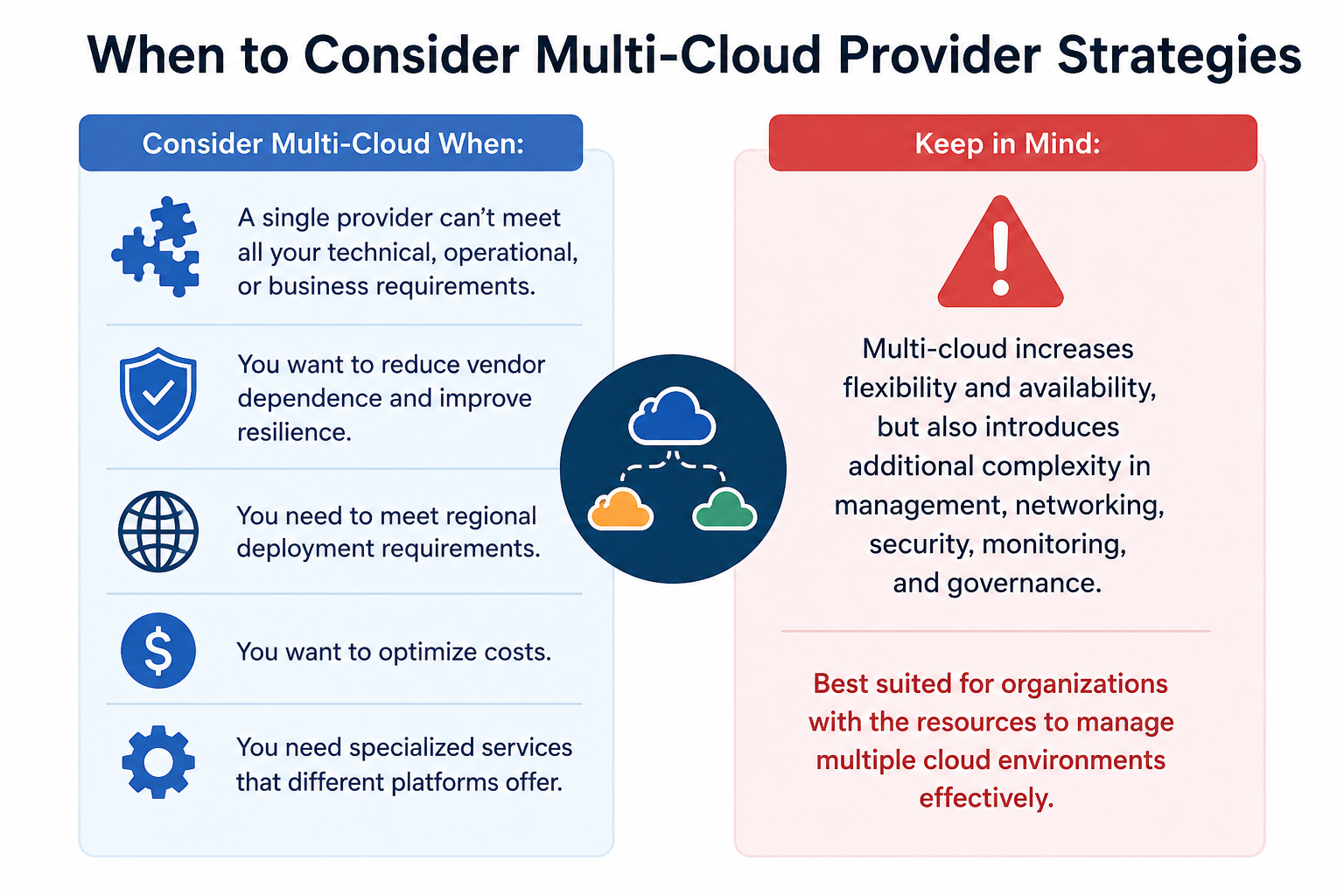
A multi-cloud strategy is worth considering when a single provider cannot meet all of your technical, operational, or business requirements. Organizations adopt multiple cloud providers to reduce vendor dependence, improve resilience, satisfy regional requirements, optimize costs, or use specialized services that are unavailable from a single provider.
While multi-cloud can increase flexibility and availability, it also introduces additional complexity in management, networking, security, monitoring, and governance, making it most suitable for organizations with the resources to manage multiple cloud environments effectively.
Switching Between Cloud Providers
Switching from one cloud provider to another, commonly referred to as cloud migration or cloud-to-cloud migration, may become necessary when costs increase, performance no longer meets expectations, required services no longer align with business needs, or compliance and operational requirements change. However, migrating workloads is often a complex and resource-intensive process, making it preferable to spend more time evaluating providers upfront than to perform a large-scale migration later.
Why Switching Cloud Providers Is Challenging
Cloud environments often become deeply integrated with an organization's applications, infrastructure, and operational processes. Differences in services, APIs, networking, security models, and management tools can require applications to be modified before they can run successfully on a new platform. Migrating large volumes of data, minimizing downtime, retraining teams, and validating workloads after migration also add time, cost, and complexity to the project.
Go through our cloud migration checklist to ensure an efficient transition.
How the Migration Process Works
A cloud-to-cloud migration typically begins with assessing the existing environment and identifying the applications, data, and dependencies that need to be moved. Organizations then design a migration plan, prepare the target environment, migrate workloads and data, validate that applications function correctly, and gradually transition production traffic to the new provider. Once the migration is complete, the previous environment can be decommissioned after all workloads have been verified.
Reduce Future Migration Effort
While cloud migration is sometimes unavoidable, careful provider selection can significantly reduce the likelihood of needing to migrate later. Choosing a provider that supports your long-term technical, operational, and business requirements can help avoid future migration costs and disruption. When migration does become necessary, using open standards, containers, and infrastructure as code can improve portability and simplify the transition between providers.
Making the Right Cloud Provider Choice
Choosing a cloud service provider is a long-term decision that affects your organization's performance, security, scalability, and operational costs. By evaluating your technical requirements, business objectives, pricing, support, security, and future growth plans, you can identify a provider that aligns with both your current workloads and long-term strategy. Taking the time to compare providers carefully helps ensure a reliable cloud environment that can adapt as your business evolves.