Classical computers are exceptionally powerful, but some problems involving massive datasets or countless possible outcomes can take impractically long to solve. Quantum computing offers a new approach by leveraging the principles of quantum mechanics to process certain complex calculations far more efficiently than traditional systems.
This article explains what quantum computing is, how it works, its key components, benefits, challenges, and real-world applications.
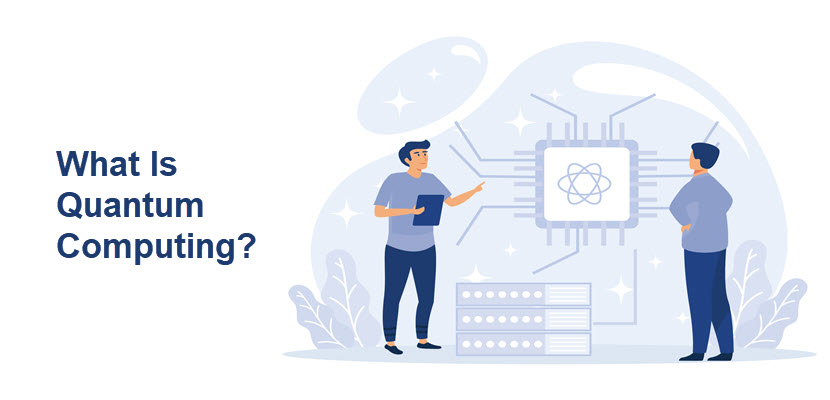
What Is Quantum Computing?
Quantum computing is a computing paradigm that uses the principles of quantum mechanics to process information in ways that differ fundamentally from classical computing.
Instead of representing data as bits that can only exist as 0 or 1, quantum computers use quantum bits, or qubits, which can exist in combinations of 0 and 1 simultaneously through a property known as superposition. Qubits can also become entangled, allowing them to share information in ways that enable highly coordinated computations. Quantum algorithms manipulate these superposed and entangled states using quantum interference, amplifying the probability of correct solutions while suppressing incorrect ones.
By combining superposition, entanglement, and quantum interference, quantum computers can process many possible computational states simultaneously for certain types of problems, making them well suited for complex calculations that are difficult or impractical for classical computers.
Learn more about high-performance computing and how it enables complex computing operations.
Quantum Computing Principles
Quantum computing is built on several fundamental principles of quantum mechanics that have no equivalent in classical computing. Together, these principles determine how quantum computers store, process, and manipulate information, enabling them to solve certain complex problems in ways that conventional computers cannot. Understanding these concepts provides the foundation for learning how quantum computers work.
Superposition
Superposition is one of the fundamental principles of quantum computing. Unlike a classical bit, which can only hold a value of 0 or 1, a qubit can exist in a combination of both states simultaneously until it is measured. This property allows quantum computers to represent and process many possible solutions at the same time.
While superposition does not guarantee faster performance for every task, it provides the foundation for quantum algorithms that can solve certain complex problems much more efficiently than classical computers.
Entanglement
Entanglement is a quantum phenomenon in which two or more qubits become correlated so that the state of one is directly related to the state of another, even when they are physically separated. This relationship enables quantum computers to coordinate multiple qubits as a single computational system rather than as independent units.
Entanglement is essential for many quantum algorithms because it allows information to be processed in ways that are impossible in classical computing, increasing the computational power available for specific types of calculations.
Uncertainty
The uncertainty principle states that certain properties of quantum particles cannot be measured with perfect precision at the same time. In quantum computing, measuring a qubit changes its quantum state, causing it to collapse into a definite value. As a result, quantum systems must perform calculations while qubits remain unmeasured, with observations taking place only after the computation is complete. This behavior requires quantum algorithms to be carefully designed so that the final measurement is most likely to produce the correct result.
Interference
Interference is the process by which quantum states combine to strengthen or weaken the probability of different outcomes. Quantum algorithms use constructive interference to increase the likelihood of correct answers while destructive interference suppresses incorrect ones. Instead of randomly selecting from all possible states, a quantum computer manipulates probability amplitudes so that the desired solution becomes more likely to appear when the qubits are measured. This ability to guide probabilities is one of the key mechanisms that enables quantum algorithms to outperform classical methods for certain problems.
Decoherence
Decoherence occurs when qubits interact with their surrounding environment and gradually lose their quantum properties, such as superposition and entanglement. External influences, including heat, electromagnetic radiation, vibration, and other forms of noise, can introduce errors into quantum computations.
Because of decoherence, today's quantum computers can only maintain stable quantum states for a limited period, making error correction and precise environmental control critical to their operation. Reducing decoherence remains one of the biggest engineering challenges in building reliable, large-scale quantum computers.
Quantum Computing Components
A quantum computer consists of several specialized components that work together to perform quantum computations. While they serve roles similar to those found in classical computers, they operate according to the principles of quantum mechanics.
Qubits
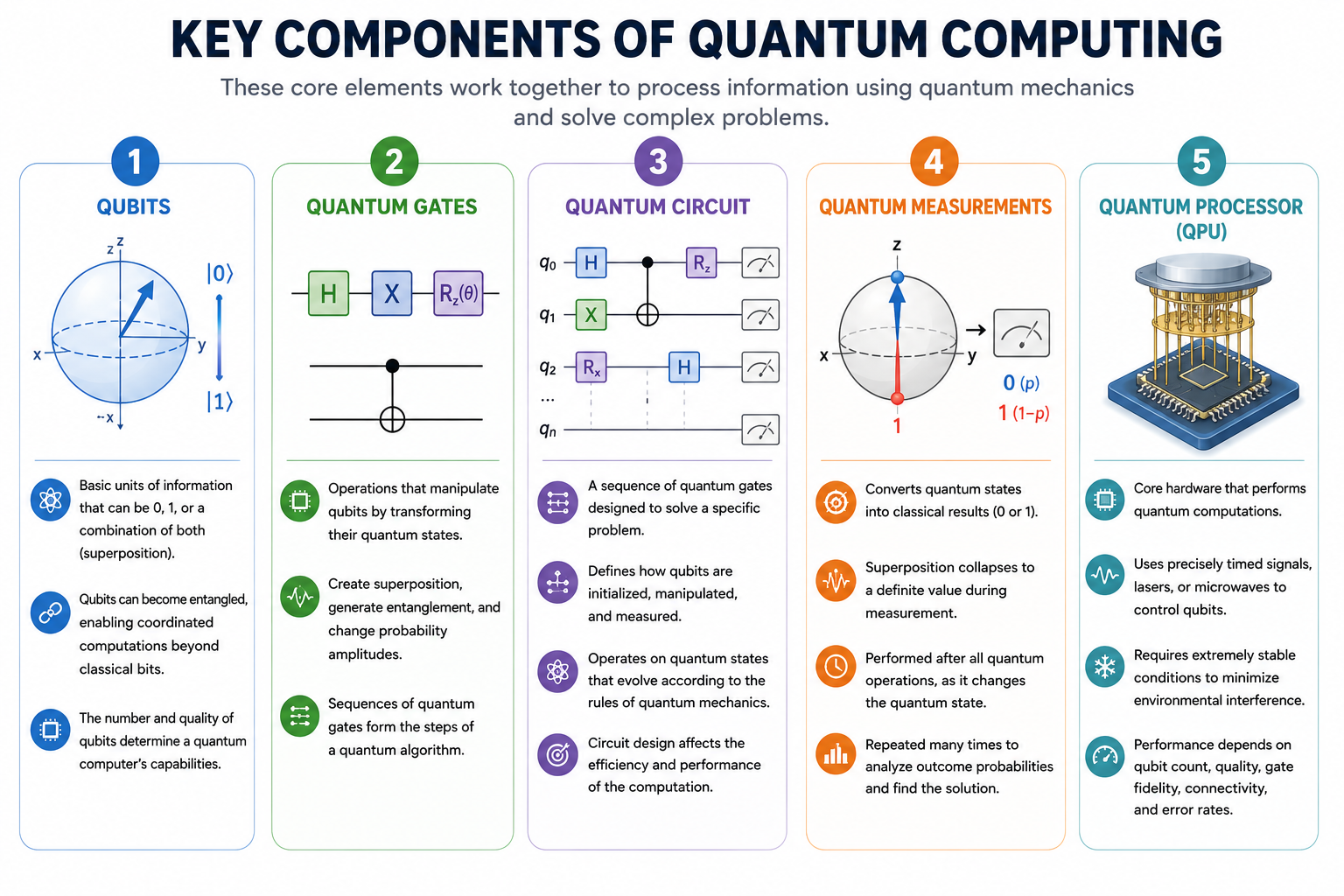
Qubits, or quantum bits, are the basic units of information in a quantum computer. Unlike classical bits, which can only represent a 0 or a 1, qubits can exist in a combination of both states through superposition. Multiple qubits can also become entangled, allowing them to perform coordinated computations that are not possible with classical bits. The number and quality of qubits largely determine a quantum computer's computational capabilities.
Quantum Gates
Quantum gates are the operations that manipulate qubits during a computation. Similar to logic gates in classical computers, they perform mathematical transformations on quantum states instead of simple binary operations. Quantum gates can change a qubit's probability amplitudes, create superposition, generate entanglement, and prepare qubits for subsequent operations. By applying sequences of quantum gates, a quantum computer executes quantum algorithms.
Quantum Circuit
A quantum circuit is a sequence of quantum gates arranged to solve a specific computational problem. It serves as the execution plan for a quantum algorithm, defining how qubits are initialized, manipulated, and measured throughout the computation. Unlike classical circuits, which process deterministic binary values, quantum circuits operate on quantum states that evolve according to the rules of quantum mechanics. The design of the circuit determines how efficiently a quantum computer performs a given task.
Quantum Measurements
Quantum measurements convert the quantum state of qubits into classical information that can be interpreted by a computer or user. During measurement, a qubit's superposition collapses into a definite value of either 0 or 1. Because measurement changes the quantum state, it is typically performed only after all quantum operations have been completed. Many quantum algorithms are executed repeatedly so that the probability of different measurement outcomes can be analyzed to determine the correct solution.
Quantum Processor
The quantum processor, often called the Quantum Processing Unit (QPU), is the core hardware that performs quantum computations. It contains the physical qubits and the control systems needed to manipulate them using precisely timed electromagnetic signals, lasers, or microwave pulses, depending on the underlying technology. The processor must maintain extremely stable operating conditions to minimize errors caused by environmental interference. Its performance depends not only on the number of qubits it contains but also on factors such as qubit quality, gate fidelity, connectivity, and error rates.
Traditional vs. Quantum Computing
Traditional and quantum computers both process information, but they do so in fundamentally different ways.
Classical computers use bits that represent either a 0 or a 1 and execute calculations sequentially or in parallel using conventional processors. Quantum computers use qubits, which leverage quantum phenomena such as superposition and entanglement to process information differently. As a result, quantum computers can solve certain highly specialized problems, such as optimization, cryptography, molecular simulation, and complex mathematical modeling, much more efficiently than classical systems.
Quantum computers are not faster for everyday computing tasks such as web browsing, office applications, or gaming. Instead, quantum computers are expected to complement classical computers, with each being used for the workloads they handle best.
Bit vs. Qubit
The fundamental difference between classical and quantum computing lies in how information is represented. A classical computer stores data using bits, each of which can hold only one value at a time: either 0 or 1. A quantum computer uses qubits, which can exist in a combination of both states simultaneously through superposition.
Multiple qubits can also become entangled, allowing them to work together in ways that have no classical equivalent. While adding more classical bits increases processing capacity linearly, adding qubits increases the computational space exponentially for certain algorithms. This unique behavior enables quantum computers to tackle specific problems that would be impractical or impossible for even the most powerful classical supercomputers.
That said, it is important to note that maintaining stable qubits remains one of the technology's greatest engineering challenges as qubits are extremely sensitive to even tiny disturbances such as heat, electromagnetic radiation, or vibrations.
How Does a Quantum Computer Work?
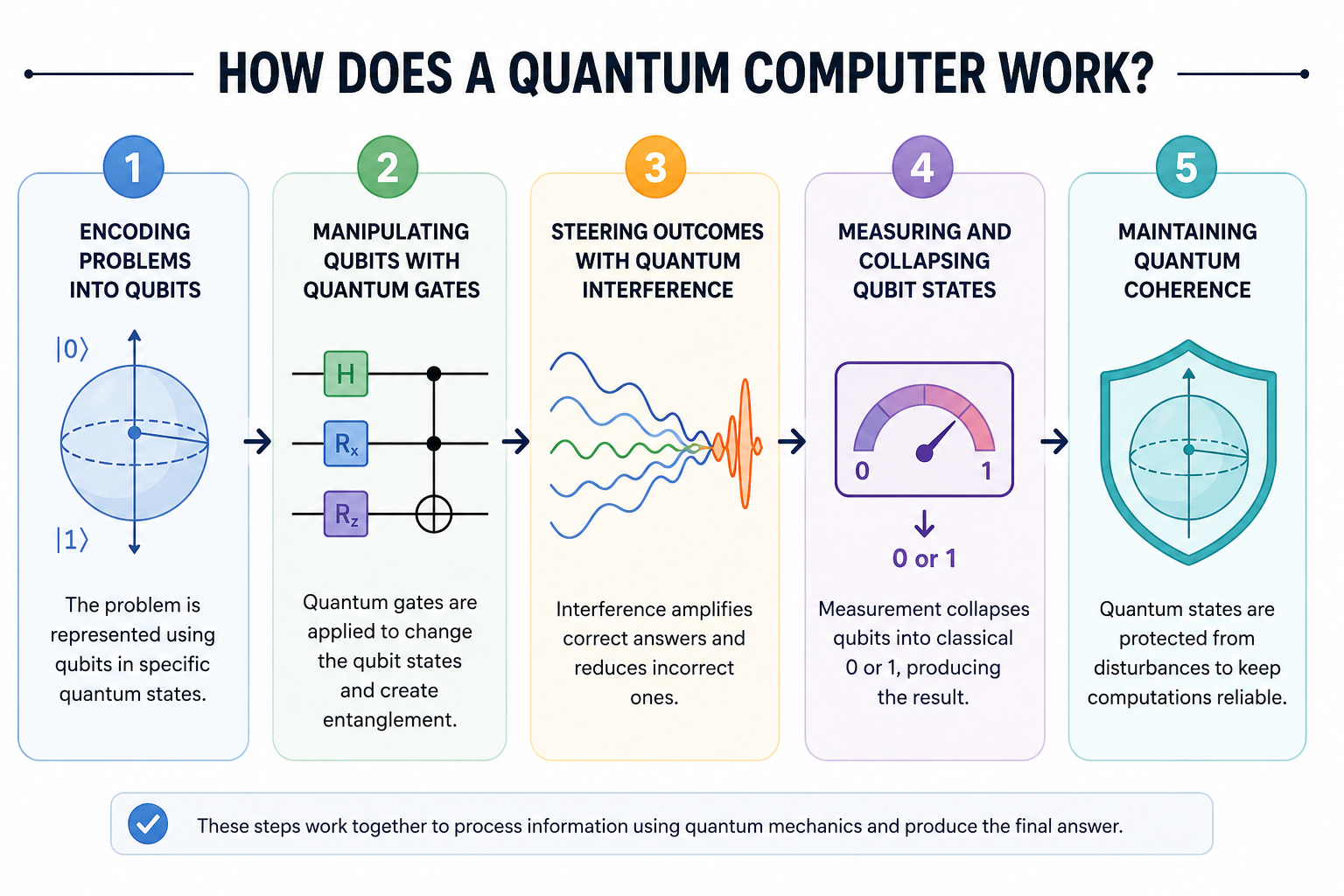
A quantum computer solves problems by preparing qubits, manipulating their quantum states, and measuring the final result. Unlike a classical computer, which performs calculations by processing bits through logic gates, a quantum computer uses quantum phenomena to explore many possible computational paths before producing an answer. Although the underlying physics is complex, the overall process can be understood as a sequence of five key steps.
1. Encoding Problems into Qubits
The first step is to represent the problem using qubits. Depending on the algorithm, qubits are initialized into specific quantum states that encode the input data or the possible solutions to the problem. Through superposition, each qubit can represent multiple states simultaneously, allowing the quantum computer to work with a much larger computational space than an equivalent classical system.
2. Manipulating Qubits with Quantum Gates
Once the qubits are initialized, the quantum processor applies a carefully designed sequence of quantum gates. These gates modify the quantum states by creating superposition, generating entanglement, and transforming probability amplitudes. Together, the gates implement a quantum algorithm that guides the computation toward the desired solution.
3. Steering Outcomes with Quantum Interference
As the computation progresses, quantum interference adjusts the probability of different outcomes. Constructive interference increases the probability of correct solutions, while destructive interference reduces the likelihood of incorrect ones. Rather than evaluating every possible answer individually, the algorithm shapes the quantum state so that the most likely measurement corresponds to the correct result.
4. Measuring and Collapsing Qubit States
After all quantum operations have been completed, the qubits are measured. Measurement causes each qubit to collapse from its quantum state into a definite classical value of either 0 or 1. Because quantum measurements are probabilistic, the same computation is often repeated many times to verify the results and identify the most likely correct answer.
5. Maintaining Quantum Coherence
Throughout the computation, the quantum processor must preserve the qubits' fragile quantum states. External factors such as heat, electromagnetic interference, and vibration can cause decoherence, introducing errors before the calculation is complete. To minimize these effects, quantum computers operate in highly controlled environments, often at temperatures close to absolute zero, while relying on sophisticated error correction techniques and precise control systems to maintain reliable computations.
Although quantum computing and artificial intelligence are separate technologies, researchers are exploring how quantum processors could accelerate certain machine learning tasks and how AI can improve the performance and reliability of quantum computers.
Types of Qubits
Not all quantum computers use the same type of qubit. Researchers and technology companies are developing several qubit technologies, each with different advantages, limitations, and engineering challenges. Some prioritize faster computation, while others focus on longer stability, higher accuracy, or easier scalability. As a result, different quantum computing platforms are better suited for different applications and stages of development.
Superconducting Qubits
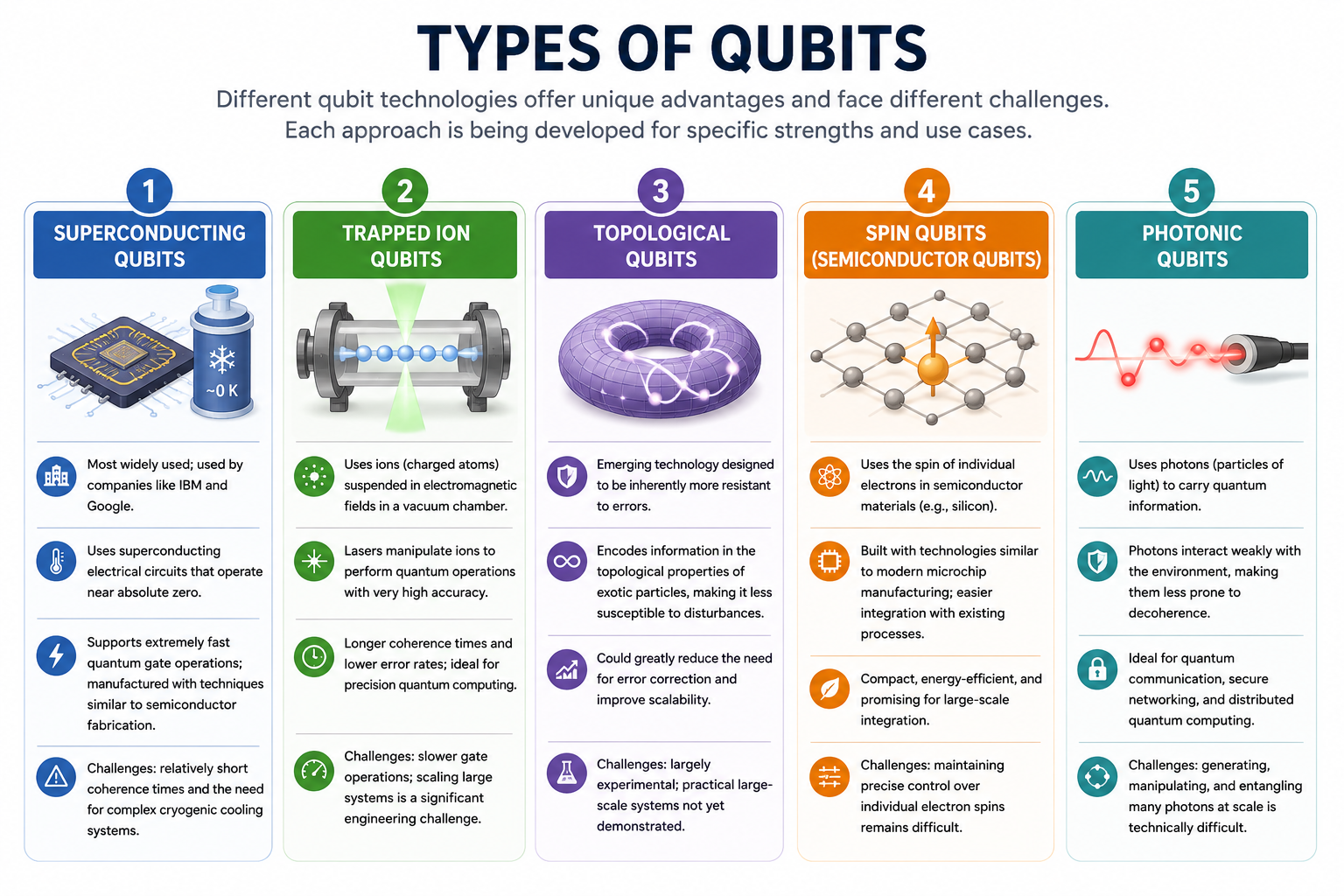
Superconducting qubits are the most widely used qubit technology today and are employed by companies such as IBM and Google. They are created using superconducting electrical circuits that operate at temperatures close to absolute zero. Superconducting qubits support extremely fast quantum gate operations and can be manufactured using techniques similar to those used in semiconductor fabrication. Their main challenges are relatively short coherence times and the need for complex cryogenic cooling systems.
Trapped Ion Qubits
Trapped ion qubits use electrically charged atoms, known as ions, that are suspended in electromagnetic fields inside a vacuum chamber. Lasers manipulate the ions to perform quantum operations with very high accuracy. Compared to superconducting qubits, trapped ions generally have longer coherence times and lower error rates, making them well suited for precision quantum computing. However, quantum gate operations are typically slower, and scaling large systems remains a significant engineering challenge.
Topological Qubits
Topological qubits are an emerging technology designed to be inherently more resistant to errors. Instead of storing information in fragile quantum states alone, they encode information in the topological properties of exotic quantum particles, making them less susceptible to environmental disturbances. If successfully developed, topological qubits could dramatically reduce the need for quantum error correction and improve scalability. However, they remain largely experimental, and practical large-scale systems have not yet been demonstrated.
Spin Qubits (Semiconductor Qubits)
Spin qubits store information using the spin of individual electrons confined within semiconductor materials such as silicon. Because they are built using technologies similar to those used in modern microchip manufacturing, they have the potential to integrate more easily with existing semiconductor fabrication processes. Spin qubits are compact, energy-efficient, and show promise for large-scale integration, although maintaining precise control over individual electron spins remains a major technical challenge.
Photonic Qubits
Photonic qubits use individual particles of light, known as photons, to carry quantum information. Since photons interact only weakly with their environment, they are less susceptible to decoherence than many other qubit types. This makes photonic qubits particularly attractive for quantum communication, secure networking, and distributed quantum computing. However, reliably generating, manipulating, and entangling large numbers of photons remains technically difficult, making large-scale photonic quantum computers an active area of research.
Quantum Algorithms
Quantum algorithms are specialized computational methods designed to take advantage of the unique properties of qubits, such as superposition, entanglement, and interference. Unlike classical algorithms, which operate on binary data, quantum algorithms manipulate quantum states to solve certain problems more efficiently. Each algorithm is designed for a specific class of computational tasks, ranging from cryptography and database searches to chemistry and optimization.
Shor's Algorithm
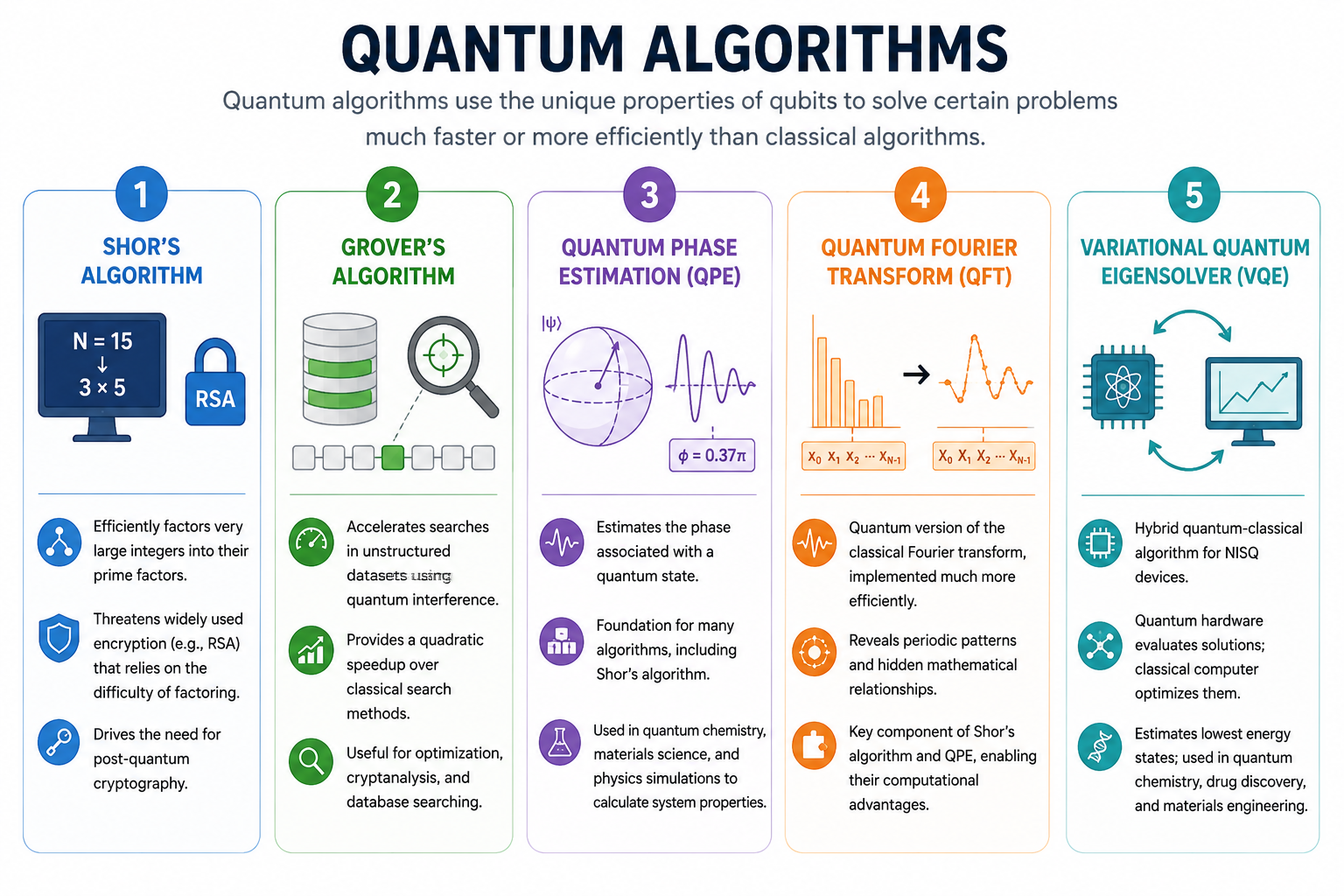
Shor's algorithm is one of the best-known quantum algorithms because it can efficiently factor very large integers into their prime factors. While this problem is extremely difficult for classical computers, a sufficiently powerful quantum computer could solve it much faster. Since the security of widely used public-key encryption systems such as RSA relies on the difficulty of integer factorization, Shor's algorithm has significant implications for cybersecurity and is a major reason for the development of post-quantum cryptography.
Grover's Algorithm
Grover's algorithm accelerates searches through unstructured datasets. Instead of checking each possible entry one at a time like a classical computer, it uses quantum interference to increase the probability of finding the correct result. Although it does not provide an exponential speedup, it offers a quadratic improvement over classical search methods, making it valuable for optimization problems, cryptographic analysis, and database searching.
Quantum Phase Estimation (QPE)
Quantum Phase Estimation is a foundational algorithm used to determine the phase associated with a quantum state. It serves as a building block for many other quantum algorithms, including Shor's algorithm, and is widely used in quantum chemistry, materials science, and physics simulations. By accurately estimating quantum phases, QPE helps calculate properties such as molecular energy levels and the behavior of complex quantum systems.
Quantum Fourier Transform (QFT)
The Quantum Fourier Transform is the quantum counterpart of the classical Fourier transform, but it is implemented much more efficiently on a quantum computer. Rather than analyzing signals directly, QFT transforms quantum states into a form that reveals periodic patterns and hidden mathematical relationships. It is a core component of several quantum algorithms, including Shor's algorithm and Quantum Phase Estimation, enabling many of their computational advantages.
Variational Quantum Eigensolver (VQE)
The Variational Quantum Eigensolver is a hybrid quantum-classical algorithm designed for today's noisy intermediate-scale quantum (NISQ) computers. It combines a quantum processor with a classical computer, where the quantum hardware evaluates possible solutions while the classical system continuously optimizes them. VQE is primarily used to estimate the lowest energy states of molecules and materials, making it one of the most promising algorithms for quantum chemistry, drug discovery, and materials engineering.
Quantum Computing Use Cases
Here are the most common use cases of quantum computing:
- Materials science. Researchers can model the atomic structure of new materials to design stronger alloys, more efficient batteries, advanced semiconductors, and high-performance superconductors without relying solely on costly laboratory experiments.
- Financial modeling. Financial institutions can use quantum computing to optimize investment portfolios, improve risk analysis, detect fraud, and perform complex market simulations involving thousands of interconnected variables.
- Optimization problems. Quantum algorithms can evaluate large numbers of possible solutions to improve logistics, supply chain management, manufacturing schedules, transportation routes, and resource allocation.
- Cryptography and cybersecurity. Quantum computers have the potential to break some widely used encryption methods while also enabling new forms of quantum-safe cryptography and secure communication technologies.
- Artificial intelligence and machine learning. Researchers are exploring how quantum computing can accelerate the training of certain machine learning models, improve optimization tasks, and process extremely large datasets more efficiently.
As quantum hardware continues to mature, the number of practical applications is expected to grow.
Quantum Computing Challenges
Despite its enormous potential, quantum computing is still in the early stages of development. Its challenges include:
- Decoherence. Qubits are highly sensitive to their surroundings and can quickly lose their quantum state due to heat, electromagnetic interference, or vibration. This limits the amount of time available to perform reliable computations.
- Scalability. Increasing the number of qubits while maintaining their stability, accuracy, and connectivity is one of the biggest challenges facing quantum hardware. Scaling from hundreds to millions of reliable qubits remains a long-term goal.
- Cryogenic cooling requirements. Many quantum computers, particularly those using superconducting qubits, must operate at temperatures close to absolute zero. Maintaining these conditions requires complex and expensive cooling systems.
- Limited hardware maturity. Current quantum processors contain relatively few high-quality qubits compared to what is needed for many practical applications. Today's systems are still considered experimental for most large-scale commercial workloads.
- Quantum error correction overhead. Correcting errors often requires many physical qubits to create a single reliable logical qubit. This significantly increases the hardware requirements for fault-tolerant quantum computing.
- High development costs. Building and operating quantum computers requires specialized facilities, advanced manufacturing techniques, and sophisticated control systems, resulting in substantial research and infrastructure costs.
- Security transition. As quantum computing advances, organizations must prepare to replace vulnerable encryption methods with quantum-resistant cryptography, a transition that will require significant planning and investment.
Although these challenges are substantial, steady progress is being made in quantum hardware, error correction, and algorithm design.
The Future of Quantum Computing
Quantum computing represents a fundamental shift in how complex computational problems can be solved. While technology is still evolving and faces significant technical challenges, continued advances in quantum hardware, error correction, and algorithms are steadily bringing practical applications closer to reality.
Although classical computers will remain the primary choice for everyday computing, quantum computers are expected to become powerful complementary systems for solving specialized problems across science, engineering, finance, healthcare, and many other industries.